Abstract
Housing First was developed as an alternative model of support for adult rough sleepers, but has since been expanded to other client groups, including young people (aged 18-25). Yet, there is a lack of research around Housing First for Youth in a UK context. This paper seeks to support the development of a UK-specific Housing First for Youth model, and to provide insight more generally into how ‘helpful’ support can be enabled, through undertaking a qualitative case study of a Housing First for Youth programme. The research finds six elements which interact to create ‘helpful’ support: 1) Separation of housing and support; 2) Choice and control; 3) Relationships; 4) Consistency; 5) Responsiveness; 6) Attentiveness. Drawing on psychosocial theory, the paper argues that there are two critical components underpinning these elements: 1) A relational approach that aligns with Jessica Benjamin’s notion of ‘thirdness’ (Benjamin, 2017); 2) Supportive working conditions for staff. The paper ultimately highlights the importance of a relational approach to both staff and young people if services are to effectively engage and support young people.
Introduction
There has been a rising interest in Housing First as a potential panacea to ending homelessness in contrast to ‘housing ready’ models. ‘Housing ready’ models provide time-limited housing and support that is conditional on compliance with behavioural regulations and rent payment, with an ultimate goal of preparing clients for independence (Stewart, 2019; Hoolachan, 2022; O’Shaughnessy & Greenwood, 2021).
In contrast, Housing First provides housing as a non-conditional right alongside open-ended, person-centered support that centres client autonomy (O’Shaughnessy & Greenwood, 2021). Due to the model’s success with street homeless adults (Mackie et al., 2019), it has since been expanded to other client groups, leading to the development of Housing First for Youth (HF4Y).
Canadian scholar Gaetz (2019) developed five guiding principles for HF4Y (1) Right to housing with no conditionality, though the housing model itself is not prescribed; (2) Youth empowerment and choice; (3) A focus on wellness and development; (4) Individualised support that is not time limited; (5) Promotion of social inclusion and community integration. These principles form the basis of HF4Y services in the UK (Housing First Europe Hub, 2025; Homeless Link, 2023). There are at least nineteen HF4Y services across England, Scotland and Wales (Housing First Europe Hub, 2025; Rock Trust, 2026; Homeless Link, 2023).
However, the majority of available research on HF4Y originates from North America. This is problematic where the North American application of HF4Y varies from the UK application in terms of client group; the housing model; and the baseline intervention it operates against (Woodhall-Melnik et al., 2025; Wood et al., 2024). The application of HF4Y in the UK varies particularly in terms of service size and the type of accommodation it is delivered in (Housing First Europe Hub, 2025). Nevertheless, research and practitioner knowledge indicate the most common housing model is dispersed social housing tenancies (Blood et al., 2020; Dixon et al., 2021), against a baseline intervention of supported accommodation. In contrast, in North America, HF4Y has often been applied in private rented accommodation or transitional housing (Woodhall-Melnik et al., 2025), the latter of which operates similarly to supported accommodation (Munson et al., 2017), against baseline interventions which include no access to housing (Wood et al., 2024). Further, HF4Y in the UK is predominantly used for those with multiple and complex needs for whom other interventions have been unsuccessful (Housing First Europe Hub, 2022; Blood et al., 2020; Dixon et al., 2021). In contrast, in Canada HF4Y is universal practice for all young people experiencing homelessness with varying levels of support need. Thus, the available research from North America lacks applicability in a UK context.
This paper is a piece of insider research, originating from the author’s experience working with a HF4Y service in a London borough. This service was recognised by both the author and other professionals as able to engage and meaningfully support young people (aged 18-25) with histories of non-engagement with services. Beyond supporting the development of a UK-specific HF4Y model, the paper intends to provide insight more generally into how support becomes experienced as ‘helpful’ by clients.
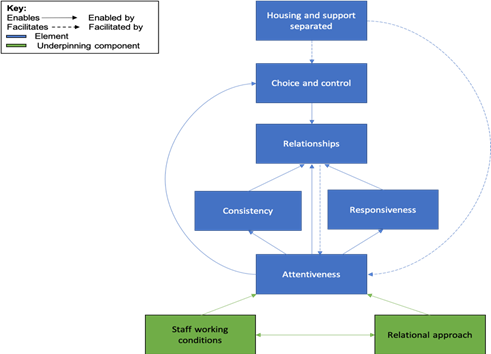
The research consists of observation of staff office days, and qualitative semi-structured interviews with four clients and four staff members to examine the critical components that enable a support interaction that clients experience as ‘helpful’. The paper finds six interlinking elements: 1) The separation of housing and support; 2) The embedding of both client and staff members’ choice and control to deliver support in a tailored way; 3) Positive and egalitarian relationships between clients and staff; 4) Consistency; 5) Responsiveness to clients’ needs, and risks; 6) Attentiveness (Helleren, 2021), referring to the ability to understand clients as individuals with struggles and strengths, through staff being curious. The paper identifies attentiveness as the critical element for ‘helpful’ support which enables clients to experience a fundamental transformation in their relation to themselves and others.
Drawing on psychosocial theory, the paper identifies two key components crucially underpinning these six elements. Firstly, a relational approach aligning with Jessica Benjamin’s notion of ‘thirdness’ (Benjamin, 2017), that accepts the reality of clients as agentic individuals who are capable of defining their own lives and are separate to, but in mutual relation with, the support worker. Secondly, staff working conditions, in particular staff having autonomy, low caseloads, and receiving peer support. These key components interact, whereby a relational approach between staff enables staff to feel supported. A supportive environment in turn enables staff to avoid falling into psychic defences and instead maintain a relational approach to clients. These findings ultimately highlight the criticality of a relational approach, and the key role of supporting staff both structurally and relationally to work through the inevitable complexities of supporting work.
Literature review
The housing-rights approach underpinning Housing First is linked to the notion of ‘ontological security’. ‘Ontological security’ is a concept originally articulated by psychiatrist R.D. Laing to describe a state where ‘identity and autonomy are never in question’ (Laing, 1960, as cited in Gurney, 2021). This concept has since been adopted by Housing Studies scholars to suggest that secure tenure provides a stable ‘material and social context’ that enables the development of identity and autonomy (Padgett, 2007, as cited in O’Shaughnessy & Greenwood, 2021, p.345). Housing First follows this logic, based on the assumption housing enables wider recovery. Yet, the lack of research within the UK and the inconsistency of the housing model in the research from North makes it difficult to assess the role of housing in HF4Y.
The assumption that home creates ‘ontological security’ also makes normative assumptions about ‘home’ as an uncomplicated, safe space of identity formation (Baxter & Brickell, 2014; McCarthy, 2020). Yet, young people utilising H4FY services often have histories of institutional environments that can be experienced as both ‘home’ and ‘unhome’ (Hoolachan, 2022; Clark et al., 2014; Littman et al., 2024). Research indicates even once in social housing young people may have ongoing fears of homelessness (Palmer et al., 2022), suggesting these past experiences and ongoing precarity may inhibit the construction of ontological security.
Beyond housing, evidence indicates non-conditionality, autonomy and tailored support are crucial elements for support to be experienced as ‘helpful’. Conditionality, regulations, and prescriptive support in supported accommodation can constrain the development of the psychological and practical skills needed to live independently (Hoolachan, 2022; Munson et al., 2017). Young people can respond to constrained autonomy by developing ‘self-reliant’ identities, mistrusting and disengaging from services (Hébert et al., 2016; Natalier & Johnson, 2015; Törrönen et al., 2023; Pryce et al., 2017 as cited in Barratt et al., 2020, p.870; Prendergast et al., 2024; Helleren, 2021). Both evaluations of UK H4FY programmes found the flexibility, non-conditionality, and tailored nature of services was crucial to enabling relationships and in turn enabling positive outcomes for clients (Blood et al., 2020; Dixon et al., 2021).
Young people with histories of relational disruption also find it particularly difficult to trust people and have developed defence mechanisms to protect against further loss (Ward, 2011; Natalier & Johnson, 2015; Hébert et al., 2016; Törrönen et al., 2023). High caseloads, administrative demands, and staff turnover can also constrain the ability to build meaningful relationships between support staff and clients (Helleren, 2021), and leads to inconsistent support, which in turn has been linked to disengagement (Prendergast et al., 2024). In comparison, HF4Y workers have low caseloads, enabling time to build relationships through persistent support. The persistence and consistency of support has been linked to the success of HF4Y in the UK (Blood et al., 2020; Dixon et al., 2021). More generally, continuity of support and a strong relationship with a caring worker has been linked to engagement in support (Prendergast et al., 2024; Munson et al., 2017; Helleren, 2021). In summary, whilst existing research indicates some critical elements of a UK HF4Y model, further research is thus needed to interrogate the role of housing in creating a ‘helpful’ support interaction, and thus to define an appropriate UK HF4Y model.
Methodology
Theoretical approach
Psychosocial scholars recognise the psychic and the social as deeply imbricated, and productive of one another (Froggett, 2012). Particularly critical to psychosocial theory is Kleinian object relations theory (Hoggett, 2008; Hunter, 2015; Froggett, 2002, 2012). Klein suggested everyone has both loving and destructive impulses. For Klein, external objects (people) become internalised and imbued with these impulses, producing internal representations of others (internal objects), which shape one’s ongoing relation to the self and others. Klein theorised two key object relations: the paranoid-schizoid and the depressive position. The paranoid-schizoid position is a state produced by intense anxiety resulting both from the baby’s vulnerability at the hands of its mother, and its destructive feelings toward its’ mother when the mother inevitably cannot meet all its needs. To defend itself, the baby splits the mother into the ‘good’ breast, which feeds and loves, and the ‘bad’ breast, which withholds food and causes pain. Because the baby fears its own destructive urges toward the ‘bad’ breast, it projects these into the ‘bad’ breast, which becomes experienced as persecuting. And, the baby projects loving feelings into the ‘good’ breast, thus protecting it. In contrast, in the depressive position, the baby begins to reconcile that the ‘good’ and ‘bad’ breast belong to the same mother. This in turn allows the baby to reconcile its own internal objects, recognising it both loves but also sometimes wishes to destroy the mother (Segal, 2004; Segal, 1973).
Psychosocial theory draws attention to the role of ‘splitting’ within the support encounter. On an individual level, projected defences against ones’ own ‘bad’ objects can manifest in staff desiring to destroy the bad ‘other’ (i.e. the client) by either cleansing them into normative modes of living, or violently excluding them (Scanlon & Adlam, 2006). On a systemic level, ‘bad’ elements in a service likewise can be projected out, creating a narrative that the service in question is unique in defending the ‘good’ client, whereas the wider system and other professionals are ‘bad’ and persecuting (Scanlon & Adlam, 2012). On both an individual and systemic level, such splitting ultimately operates to preserve the illusion of a ‘good’ inside and defend against feelings of helplessness (Hunter, 2015; Scanlon & Adlam, 2012).
Jessica Benjamin’s (2017) notion of ‘thirdness’ offers a mechanism to overcome this splitting. Benjamin suggests ‘thirdness’ requires ‘intersubjectivity’, whereby psychoanalyst and patient recognise one another as a distinct ‘like subject’ to ‘be with’ rather than destroy or resist (Benjamin, 2017, p.22, 24). Critical to this is the analyst and patient integrating their own and one anothers’ internal objects. This reconciliation ultimately breaks down binaries between ‘knower’ and ‘known’, ‘doer’ and ‘done to’, recognising instead that the analyst as fallible and the patient is capable. This recognition enables a ‘two-way directionality’ between analyst and patient, allowing the co-construction of the analytical encounter (Benjamin, 2017, p.33, 23). Whilst intended within psychoanalytic practice, Benjamin’s work can provide a path to overcoming psychic defences in other supported/supporter binaries.
A psychosocial approach also captures the complex positionality of staff. Rather than simply conceptualising frontline workers as enforcers or resistors of oppressive top-down policies (Dobson, 2015, 2020), the concept of ‘relational identity’ (Hunter, 2003) recognises workers have dynamic identities that are shaped by a range of factors including lived experience, identity position, institutional position, and the unconscious. This concept likewise highlights that workers can traverse positions of authority and subordination at the same time (Hunter, 2015; Dobson, 2020). This is particularly fitting for homelessness workers, who are both precarious: low-paid; non-professionalised; and marginal to statutory services (Helleren, 2021), but equally in a position of authority over clients. ‘Relational identity’ thus highlights the dynamism of the support encounter.
Psychosocial scholars understand the researcher too is driven by unconscious defences (Lewis, 2010). This approach thus moves away from positivist notions of the researcher as an objective outsider (Furlong & Marsh, 2010). Yet, rather than eschewing objectivity, this paper draws on Haraway’s (1991) ‘feminist version of objectivity’. Feminist objectivity requires a deep understanding of a specific context that the researcher is accountable to, and that is co-constructed with participants (Haraway, 1991, p.186; Spencer et al., 2014). Drawing on critical social realism, the paper also seeks to establish the existence of ‘real’ generative mechanisms underlying a ‘helpful’ support encounter (Sayer, 1992).
Research and analysis methods
A qualitative case study approach has thus been selected to provide depth; capture dynamism; enable knowledge co-creation with participants; and ultimately illuminate underpinning mechanisms. A psychosocial approach in turn enhances this account through acknowledging the psyche as ‘real’ and potentially generative of, and generated by, the social world.
The service, LHF4Y, operates in a London borough and is delivered by a youth homelessness charity. LHF4Y works with young people (clients), aged 18-25. Clients are referred by the local authority and are either accommodated under the Housing Act (1996) as homeless or are care leavers, and have histories of struggling in mainstream support services. The model is delivered in social housing tenancies which are not tied to engagement in support. Tenancies are dispersed across the borough, and landlords vary from the local authority to various Housing Associations. At the time of writing, LHF4Y worked with fifty-six clients, and employed twelve Housing First officers (HFOs), alongside a Deputy Manager and a Manager. Each HFO has a caseload of five clients. HFOs have minimum weekly contact with clients, providing support around tenancy sustainment and wider needs such as wellbeing. The team are supported by a range of in-house services, including an embedded psychology and psychotherapy service and a specialist employment support team.
This study drew on interviews with four clients using LHF4Y: Rubina, Leah, Ocean and Joe, and four HFOs: Julie, Em, Jack and Duncan1, in addition to observation of four weekly team office days. Clients were recruited through support workers, with the exception of one client who was approached directly, based on a criterion of clients who were working well with LHF4Y but had negative past experiences of support. Of the clients recruited, one was a care leaver and the remainder had previously been homeless. Clients had been supported by LHF4Y for a varying range of time, from six months to two and a half years, and all had experience of ‘housing ready’ services as well as a range of other voluntary and statutory services. HFO interviewees were selected for their diversity in length of service, ethnicity, gender, and employment backgrounds, and approached directly to participate in an interview. These staff members all had experience in supported accommodation and other voluntary and statutory services. Their length of service ranged from six months to having worked in LHF4Y since its inception two and a half years ago. Demographic data was not requested from participants. Ethical approval for the project was granted through Birkbeck, University of London.
A semi-structured approach was utilised for all interviews. Interviews with clients focused on current and past experiences of support. Interviews with staff focused on what they felt ‘worked’ in LHF4Y. Following initial interviews, clients were offered the opportunity for a follow-up interview to clarify initial analysis. Ocean and Rubina took part in a follow-up unstructured interview. Clients were paid incentives for partaking in interviews: £15 vouchers for the first and £25 vouchers for the second. Interviews took place in person, at locations ranging from LHF4Ys’ offices, to clients’ homes, to clients’ workplaces, with the exception of one interview with an HFO which took place online. Interviews were recorded and auto-transcribed using Microsoft Teams and then edited for accuracy. Observation data consisted of fieldnotes.
Data was analysed using thematic analysis, with themes developed through the data and literature (Braun & Clarke, 2006 and 2013, as cited in Bryman, 2021, p.538). Identifying psychic processes requires attending to affective states accompanying discourse (Lewis, 2010; Dobson, 2020). Thus, analysis focused both on what participants said but also how it was said. When analysed in conjunction with theory, this data thus indicated underpinning psychic mechanisms. Following analysis of individual datasets, analysis was then amalgamated, which led to the refining of themes and the mapping of relationships between them to reveal underpinning generative mechanisms.
Positionality
Psychosocial research implores reflexivity about the researchers’ psychic defences (Lewis, 2010). I had worked with LHF4Y for several years as a commissioner prior to undertaking this research. Through learning about object relations theory, it became clear that the research had originated out of splitting, whereby LHF4Y became the ‘good object’, against ‘bad’ mainstream services. This splitting acted as a defence against my own anxieties about my inability to make change in an unwieldy system. I thus had to critically attend to my defensive desire to protect LHF4Y, in order to gain an accurate understanding of my participants’ experiences, including where support had fallen short.
Though I was not undertaking the research for commissioning purposes, the power dynamics of my role were inevitably present during the research encounter. For example, staff may have tried to present a particularly positive image of LHF4Y. Likewise, clients may have been wary to provide negative feedback, or equally may have been more open about challenges due to a hope this will lead to change. Nevertheless, whilst my positionality inevitably influenced the data collection process, collecting multiple forms of data enabled triangulation to increase internal validity.
Findings
Figure 1: Model of components enabling helpful support2
Housing model
Clients experienced their social housing as ‘peaceful’, providing stability and privacy. This contrasted with supported accommodation and residential care, which were mainly, though not exclusively, experienced as restrictive, unsafe and unhomely due to nonsensical rules; lack of privacy; lack of, or poor relationships with staff and other residents; and sharing with people experienced as scary. For Leah, her flat enabled her to ‘mature… see things in a different perspective’. And, being happier due to her living conditions allowed her to ‘engage better’ in support. For Joe, his flat allowed him to reconnect with his family because he ‘was able to present myself sort of in a better way to them’. Thus, clients’ experiences of their social housing did indicate a move toward ‘ontological security’, acting as a space for identity formation and better connection to others.
Yet, the home also brought challenges. The amount of space was experienced as overwhelming for some clients, as were the responsibilities of tenancy management. One client had been without heating and hot water for two years. Some clients remained aware of the ongoing conditionality of their tenancy on complying with their tenancy agreement. There was also a perception from HFOs that some clients were not ready to manage a tenancy, which led to risky situations. The local authorities’ approach of providing ‘lettable but not liveable’ flats (Jack), and the inadequacy of allocated funds to provide fully furnished flats was also a challenge. Despite all clients being appreciative of their tenancies, it was only Joe who understood his housing as ‘the landmark’ of LHF4Y. For the others, relationships appeared more crucial: ‘(it’s) definitely more about the people’ (Ocean). The independent tenancy therefore did not appear to provide complete stability, nor did clients inherently link it to changes in their lives, thus complicating the assumption of a straightforward link between the material tenure and ‘ontological security’.
Nonetheless, the separation of housing and support was important for relationships. The conjoining of housing management and support work responsibilities in supported accommodation had created a conflict between the role of ‘supporter’ versus ‘enforcer’: ‘the person handing them the notice when they told you I can’t afford it, or I’m going through a situation’ (Em). On a systemic level, the setup of supported accommodation conflicted with purported goals. For example, high rents conflicted with the goal of getting clients into employment. For Em, this created the feeling of being ‘stuck in a loop where we weren’t actually helping’. Staff in supported accommodation thus traversed identities of both ‘subordination’, enforcing rules they had not set, and ‘dominance’ (Hunter, 2015, p.26).
The ‘enforcer’ responsibility constrained relationships between staff and clients. Rules and regulations were experienced by clients as dis-trusting: ‘You almost feel like I’ve done something wrong. Like what am I doing for you not to trust me?’ (Rubina). In turn, unannounced room checks led to Leah and Rubina feeling ‘unsafe’ and perceiving staff as ‘untrustworthy’, and for Joe, being ‘watched’ through CCTV contributed to his paranoia. Distrust of staff meant clients felt unable to reach out for support. Powerlessness and mistrust thus appeared to be the ‘dominant and enduring ‘structure of feeling’’ in supported accommodation (Fortier, 2017, p.8), circulatingbetween clients and staff (Hunter, 2015). In comparison, in LHF4Y the removal of the ‘enforcer’ role increased autonomy for clients and staff alike. This in turn created mutual trust, meaning clients opened up more. The removal of the ‘enforcer’ responsibility also enabled staff to be less ‘stressed’ and more ‘present’, allowing them to be more attentive.
Choice and control
The separation of housing and support also removed the requirement to receive support in the building, enabling clients to have more choice. HFOs described support as being ‘led’ by clients, referring to clients having choice over where they wanted to meet, how often, and what they wanted support with. Staff equally described rejecting the position of ‘expert’: ‘as a professional it’s not like I’m the one, I know everything… The young person is the one who’s teaching me how they want to be supported’ (Julie). Clients appreciated the flexibility to receive support in a range of ways and experienced choice as trusting: ‘You trust them and they trust you’ (Rubina). Increased trust was linked to clients engaging in support more, and being more open: ‘because it’s always been on my terms, it makes it a lot easier to open up. Because I don’t feel pushed’ (Ocean). In embedding clients’ control, LHF4Y thus moved beyond a ‘doer’ and ‘done to’ dynamic, instead allowing the construction of a ‘co-created reality’ between staff and clients (Benjamin, 2017, p.23, p.24), in turn facilitating trusting relationships.
Choice and control also included involving clients in making decisions at a service level. For Ocean, being involved in shaping the service allowed them to see themselves as an equal subject with value to offer: ‘I don’t feel like I’m just another person they’re helping. I also feel like I’m giving something back, which is quite nice’ (Ocean). Equally, moving beyond the ‘doer’ position transformed staff’s professional identities: ‘[clients] don’t feel so forced to have to do things because they know you can switch this off at any point, you take the lead. So I think that helps as well for both of us’ (Em). Thus, both clients and HFOs identities were deeply relational (Hunter, 2003), shaped through the promotion of autonomy, which shifted the dynamic between them.
Nevertheless, there were tensions around the reality of enabling full choice and control in a conditional world. Some HFOs understood their role as ‘teaching’ clients ‘to do things that sometimes we as adults take for granted’, and many HFOs felt clients should be prepared better before accessing their tenancy, suggesting some hangovers of a ‘housing readiness’ approach and normative ideals about what ‘success’ looked like. HFOs at times struggled with feeling that through centering choice and being responsive to clients’ immediate needs, they were potentially inhibiting people from developing the normative independence skills they needed: ‘there’s a bit of me that feels that just with, not just my presence, but our services presence, she’s allowed to sort of not do as much’. Equally, some clients felt it was important they were uniformly taught skills around tenancy management and healthy eating, suggesting clients also felt there should be limits to choice and control.
Relationships
However, relationships enabled clients and staff to navigate these tensions and cope with the conditionality of the world. Rubina described her relationships with staff and being ‘in their presence, good energy, good vibes’ helped her during ‘a stressful meeting about shit that I gotta do’. Duncan described how he’d slip in questions about paying bills during discussions about video games with a client: ‘he’s more likely to give me an honest answer. Because he wants to get that question out of the way so he can talk to me about call of duty’. Authenticity was key to these relationships, with HFOs bringing ‘that person side’ as well as the ‘professional side’ (Rubina). This authenticity was enabled by staff sharing that they too struggled, creating a feeling of equality: ‘Reminding us that we’re not below them. Yeah, that everyone goes through stuff. So I love that. Because, like, I’ve always felt really very equal’ (Ocean).
Staff autonomy also appeared crucial to forming authentic relationships. In services with authoritarian management, this constrained the creation of authentic relationships: ‘if a staff can’t feel like free, like or they feel like, I don’t know if they’ll get in trouble or whatever, maybe, it’s like they’re more restricted with you’ (Rubina). The separation of housing and support also enabled staff to do activities with clients. For clients and HFOs, these opportunities for bonding were important to relationship-building. Staff having greater autonomy to shape their interactions with clients thus enabled a move toward an authentic relationship between equal ‘like subjects’ (Benjamin, 2017, p.22). It was thus through ‘intersubjective’ (Benjamin, 2017, p.22) relationships within LHF4Y, that both staff and clients coped with the world’s conditionality.
Consistency
The consistency of support was also crucial for relationships, in contrast to experiences in services with high staff turnover. High caseloads and a lack of training and support for staff were understood by clients and staff to have caused staff turnover in other services. This contrasted with the significant support HFOs described, and I witnessed. ‘Supportive structures’ such as the allocation of second lead workers for each young person, and a duty system that provided out of hours support also enabled consistent support. These structures mitigated the potential negative impact of staff leaving on clients, and enabled responsiveness to clients’ immediate needs. Likewise, these structures allowed staff to receive support if they’d ‘just left the mental health hospital at 7:00 at night’ (Jack), and offered reassurance that ‘someone backs me up when I’m either on annual leave or off or I’m sick’ or even ‘overwhelmed and maybe I need to take a break’ (Julie).
Beyond consistency, clients also appreciated the proactivity of support, particularly during periods of struggle and disengagement. This experience contrasted with other services where clients had reached out for support and not been responded to: ‘It’s like the support is right there. And even when you don’t want it. It’s there [laughs]’ (Ocean). Staff’s low caseloads were likewise linked to persistent support: ‘We manage our own time. If we need to knock on someone’s door, four five times a week… we can do it’ (Jack). Staff working conditions therefore crucially enabled staff to persevere in supporting clients, in turn enabling consistent and persistent support which allowed trusting relationships to form.
Responsiveness
Responsiveness was also key for developing trusting relationships, referring to the ability to respond quickly and appropriately to clients’ needs. Clients all described other services’ lack of responsiveness when they reached out for support, which ultimately led to mis-trust and disengagement. Clients particularly felt failed by services not having protected them, whether from other people or themselves. For Joe, whilst staff in his supported accommodation service had been ‘friendly’ and he felt they ‘cared’, ultimately their inability to protect him from another resident meant he felt let down. Comparatively, for Leah, Ocean and Rubina, a lack of responsiveness from other services was fundamentally experienced as uncaring.
In contrast, clients reported LHF4Y was quick to respond to their requests for support and acted to protect them. HFOs were experienced as ‘on the ball’ (Joe). Clients appreciated LHF4Y’s ability to offer holistic support, from emotional support, to tenancy management, to the practical setting up of their home. The ability to respond to needs was enabled through the team being knowledgeable, and having access to a wide range of resources. The removal of housing-related responsibilities also enabled responsiveness. For Ocean, their requests for support in supported accommodation had not been met in part because of staff’s building-related responsibilities: ‘Can I speak to someone? And they’re like, yeah, we’ve only got two people on the reception right now, no one can come out.’
In turn, for clients, having their needs met by their HFO was experienced as caring. Past experiences of inconsistent and uncaring support were linked to poor self-worth; mis-trust of professionals; and disengagement from support. In comparison, for Rubina, Leah and Ocean, the experience of having their needs met was linked to improved self-feeling and perceptions of others. Rubina and Leah described restored ‘hope’ in services and other people: ‘she’s, like, changed the narrative that I had that like services like they don’t care. They don’t take responsibility’ (Leah). Restored hope in turn improved mental health, increased motivation, and allowed clients to feel able to assert their needs. HFOs were thus provided an alternative relational model which re-formulated clients’ relationships to external objects and themselves.
Attentiveness
Responsiveness crucially required attentiveness to clients. ‘Attentiveness’ (Helleren, 2021), refers to the ability to see people as they are, to ‘be with’ difficulty and paradox, and thus respond to clients as individuals, based on their context and history (Helleren, 2021, p.129). Clients appreciated staff’s ‘patience’ and tenacity to understand them. Understanding a client required understanding their history, including their trauma, and being attentive to their ongoing distress, going beyond a clients’ surface-level presentation. In contrast to their experience in other services where they felt staff deliberately ignored their distress, Ocean described their HFO’s non-judgemental curiosity: ‘I drank all night and she’ll be like, OK, why? But not in a judgemental way. What made you want to drink all night?’ For Ocean, this also offered an opportunity for self-reflection and enabled them to gain greater insight into themselves.
Being attentive enabled appropriate responsiveness. It was through taking the time to understand Ocean that their HFO was able to provide a person-centered response. Rather than seeming overwhelmed by their distress, as Ocean had experienced from staff in the past, Ocean’s HFO focused on practical solutions that were specific to their passions: ‘like they remember, you know, that sport really helps me. They remember that music is literally like my escape.’. For Ocean, their HFOs ability to see beyond their distress, and recognise their strengths, was crucial: ‘did you go to the studio this week? No, I didn’t. They’re like, well did you go to football? Actually, I did… And they’re like, well, that’s a step.’
This attention to clients’ strengths contrasted with experiences of other services, where clients felt their efforts were not acknowledged. Joe described his frustration when his supported accommodation keyworker accused him of not engaging, which ‘did really mess up my head because you know, every time I was told there’s a key session, I was there if I’m in the house… I always try and, you know, greet the staff’. This damaged Joe’s relationship with his keyworker, leading him to perceive her as dishonest, suggesting a critical link between attentiveness and relationships.
In LHF4Y, this attention to strengths also allowed staff to persevere in difficult circumstances. For Julie, the fact that her client had begun cooking meals for her baby was a strength, even if she was in high rent arrears: ‘we don’t focus on the young person’s negative side, right? We sort of like trying to promote them’ (Julie). In attending to clients’ strengths as well as struggles, HFOs instead held the reality of clients as a distinct and complex ‘like subject’ (Benjamin, 2017, p.22) and moved past destructive desires to absorb the ‘other’ into normative modes of living (Scanlon & Adlam, 2006). In turn, this approach enabled clients to integrate their own internal objects, increasing self-esteem: ‘yes, I have a lot of stuff going on, but it doesn’t mean that I can’t have fun at the same time’ (Ocean).
On the other hand, this attentive approach was inconsistent. For Joe, whilst his HFO understood he had dis-engaged with an employment support service because he was unable to secure employment quickly, Joe identified his dis-engagement as related to past trauma regarding school and employment. A lack of understanding of Joe’s needs and the role of trauma had therefore led to the provision of inappropriate support that did not address the underlying issues: ‘[past experiences] sort of knocked my confidence… sort of felt like I wouldn’t need that sort of support.’ When I asked why he hadn’t shared this information with LHF4Y, Joe suggested this was linked to his ‘bad memory’ and his head being ‘a bit fast-paced and… a bit all over the place’.
However, I believe it was the attentiveness a qualitative interview offers that enabled Joe to share. It was only after multiple questions and pauses that Joe disclosed his perception of the link between his past experiences and his dis-engagement. Observation indicated Joe’s HFO drew a clear boundary between ‘support worker’ and ‘therapist’, suggesting anxiety about uncovering and holding distress, perhaps inhibiting the curiosity needed to fully understand Joe’s dis-engagement with employment support. Joe did not describe the same close relationship with his HFO as other participants. And, whilst he appeared able to reconcile the ‘good’ and ‘bad’ in others, recognising people could ‘care’ but still let him down, Joe was self-critical during the interview. Thus, it appeared Joe had not experienced the same integration of his internal objects as Ocean. Joe’s experience therefore indicates consistency and responsiveness alone were ultimately inadequate to build a trusting relationship without attentiveness. And, without an attentive relationship, Joe was unable to experience a reformulation of his object relations.
Supported: from staff to young people
‘It’s the whole feeling of being supported and we’re trying to get it from staff to young people, transcending through both of us’ (Jack).
Attentiveness was crucially enabled by the support staff received. HFOs described an ‘ethic of care’ within LHF4Y, with consistent and proactive support from managers, peers, and the embedded psychology and psychotherapy service. It was through this that staff were able to sustain support for their clients. For example, in one team meeting an HFO discussed their struggle maintaining compassion for a client, and their desire to withdraw support from this client, who they felt unable to help. Here, the HFO demonstrated a desire to exclude the client (Scanlon & Adlam, 2006). As Jack noted, clients’ dis-engagement was challenging for the team ‘who are desperate to help. We’re all rescuers. We’re all fixers.’ Thus, the HFO’s perceived inability to help challenged their self-image, creating a defensive response that projected the ‘bad’ helplessness out and created a desire to shut out the client (Scanlon & Adlam, 2006; Hunter, 2015).
Yet, rather than disavow these tensions, through the support of their colleagues the HFO was able to work through these difficulties. The officer’s colleagues allowed them to speak openly, without judgement, showing compassion both for them and the client. One staff member reframed the clients’ actions in a strengths-based light. Peers also offered practical support, such as joint visits. By the end of the discussion, the officer stated they were feeling compassionate again and spoke about liking the client. Thus, their colleagues’ support enabled the HFO to reconcile the good and the bad in their client and themself, thus enabling them to move beyond their defensive desire to exclude the client.
Similarly, through peer support, staff were able to avoid systemic splitting whereby LHF4Y would become the uniquely ‘good’ service, ‘with’ the clients and ‘against’ other ‘persecuting’ services (Scanlon & Adlam, 2012, p.77-8). Interviews and observation indicated that the unique nature of LHF4Y could indeed result in ‘professional isolation’ for staff. At times, staff felt that services were abandoning them and their clients, leaving them to hold risk. Yet, staff likewise worked through these feelings. In one team meeting, a HFO discussed their frustration with another service. Their colleagues listened with empathy and provided practical guidance, but also encouraged perseverance. Interviews indicated HFOs conceptualised their role as being the ‘bridge’ with other services, and had supported clients to re-engage with other services. Therefore, rather than becoming isolated, HFOs built positive relationships with other services which enabled their clients to access the support they needed. The acknowledgement and working through of the challenges inherent in their work thus enabled staff to resist stagnating in psychic defences against helplessness and instead reconcile the ‘good’ and the ‘bad’ internally and systemically to persevere in supporting clients.
The promotion of staff autonomy also enabled the resolution of tensions within LHF4Y. For example, during a discussion about clients’ lack of tenancy preparation, managers both reminded HFOs that Housing First is not contingent on housing readiness, but also encouraged HFOs to create solutions, leading to an agreement to embed pre-tenancy work with clients while they waited for their flat. This alleviated anxieties about clients’ lack of ‘readiness’ whilst maintaining Housing First principles of non-conditional access to housing. Thus, staff autonomy facilitated the continued promotion of autonomy for clients, enabling staff to resist the urge to coerce the other and instead hold them as ‘like subject’ (Benjamin, 2017, p.22) deserving of housing regardless of tenancy readiness.
Concluding discussion
In summary, then, attentiveness emerged as the crucial element of a ‘helpful’ support encounter. Through attentiveness, HFOs demonstrated an alternative relational model which enabled clients to acknowledge and integrate their strengths and their struggles, and transformed their perceptions of others. For Ocean, Leah and Rubina, it was thus primarily through an attentive relationship that they constructed psychic security. Ontological security, then, is fundamentally relational rather than simply about bricks and mortar (McCarthy, 2020; Hoolachan, 2022).Where attentiveness was not fully realised, this appeared to constrain the development of trusting relationships, and did not enable LHF4Y to adequately respond to clients’ needs. These findings align with wider literature that emphasises the criticality of attentiveness (Helleren, 2021), and indicate relationships provide a basis for self-development, feelings of belonging; and the creation of ‘home’ for this cohort(Törrönen et al., 2023; Ward, 2011; Dallas-Childs & Henderson, 2020; Natalier & Johnson, 2015). Policy-makers should thus consider the importance of long-term, trusting relationships over ‘quick fix’ interventions (Hoggett, 2008, p.81), and the criticality of relational outcomes.
Whilst there was not a straightforward link between social housing and ‘ontological security’, the separation of housing and support appeared important. The restrictive nature of supported accommodation had constrained the development of positive relationships between staff and clients, and appeared to inhibit the development of ontological security, aligning with literature on the contradictory nature of supported accommodation (Hoolachan, 2022; Munson et al., 2017; Stewart, 2019). The separation of housing and support instead enabled LHF4Y to move toward ‘two-way directionality’ where clients were acknowledged as autonomous and capable of co-construction (Benjamin, 2017, p.23), constructing a dynamic of mutual trust. Nevertheless, the findings are ambiguous about the housing model itself, and further research is needed to understand whether attentiveness and autonomy can be enabled in other forms of housing to define an appropriate UK HF4Y housing model.
Underpinning attentiveness was a relational approach that closely aligned with Benjamin’s notion of ‘thirdness’ (Benjamin, 2017). In moving away from the position of ‘expert’ and in acknowledging their struggles, HFOs ‘surrendered’ to their inherent vulnerability and recognised clients as a distinct ‘like subject’ with strengths and struggles (Benjamin, 2017, p.48, 22). This recognition in turn enabled staff to move beyond destructive desires toward the client, toward ‘being with’ Benjamin, 2017, p.24). Particularly important to ‘being with’ was taking a strengths-based approach that recognised clients as capable of defining their own lives, thus centering clients’ autonomy to define their support. Consideration should thus be given to embedding ‘being with’ difference and centering client capability in policy and practice. This requires moving away from broad, pre-defined outcomes toward co-creating individual-level outcomes.
There were nevertheless tensions in enabling full choice and control for clients, as has been noted in other Housing First services (Blood et al., 2020; Hansen Löfstrand & Juhila, 2021). These tensions at times resulted in staff falling into psychic defences, desiring to ‘shut out’ their clients or isolate themselves from other professional networks to protect their own and LHF4Y’s ‘goodness’ (Scanlon & Adlam, 2006, 2012; Hunter, 2015). Yet, through the support of their colleagues, HFOs were able to confront the challenges inherent in their work, working through feelings of helplessness, resisting defensiveness to sustain ‘two-way directionality’ (Benjamin, 2017, p.23). And, through gaining more autonomy, staff were better able to personalise the support they provided, and to reconcile some of the tensions of delivering Housing First in a conditional world. The mirroring between staff and client experience further highlights the fundamentally relational nature of the support interaction (Hunter, 2003; Dobson, 2015).
Yet, there is a surprising lack of research about the link between staff and client experiences, and more generally on working conditions and challenges for staff in homelessness services, with some exceptions (McGrath & Pistrang, 2007; Helleren, 2021). Further research is thus needed on this area. Nevertheless, services should learn from LHF4Y in maximising staff autonomy and practically creating a supportive environment that allows staff to directly confront contradictions in their work and ensuing psychic defences.
In conclusion, these findings both build on existing knowledge and provide novel insights to support the development of a UK HF4Y model and future research in this area, in addition to deepening insights into supporting young homeless people, care leavers, and people with complex trauma more widely. In relation to UK HF4Y specifically, the paper indicates the criticality of a separation of housing and support, although the findings are ambiguous about the role of social housing. More widely, the paper highlights the importance of an attentive relationship in constructing a ‘helpful’ support encounter, and its transformative potential on clients’ relation to themselves and others. Through the application of psychosocial theory, this paper has enabled a deeper analysis, revealing the criticality of the working through of psychic defences to allow staff and clients to work together to co-construct a ‘helpful’ support encounter.
- All names have been changed.
- A component that ‘enables’ makes another component possible, whereas a component that ‘facilitates’ supports the other component but is not fundamentally required for the other component to be possible.
This work was supported by the National Institute of Health Research, under the Pre-Doctoral Local Authority Fellowship (NIHR305148) and is the result of a Masters dissertation funded through this Fellowship. The funder had no role in the actual undertaking of the research, such as the study design, collection, analysis, or writing.
With many thanks to the young people and staff who generously took part in this study, and to my supervisors, Dr Stephen Green and Dr Ben Gidley.
Rachel Parry, parryrachel98@gmail.com
Barratt, C., Appleton, P., & Pearson, M. (2020). Exploring internal conversations to understand the experience of young adults transitioning out of care. Journal of Youth Studies, 23(7), 869-885. CrossRef link
Baxter, R., & Brickell, K. (2014). For Home UnMaking, Home Cultures, 11(2), 133-143. CrossRef link
Benjamin, J. (2017). Beyond Doer and Done to: Recognition theory, Intersubjectivity and the Third. Routledge.
Blood, I., Alden, S., & Quilgars, D. (2020). Rock Trust Housing First for Youth Pilot: Evaluation Report. Housing First Europe Hub and Rock Trust. https://www.rocktrust.org/download/housing-first-for-youth-evaluation-report-2020
Bryman, A. (2021). Social Research Methods. 6th ed. (Oxford: OUP).
Clark, A., Cameron, C., & Kleipoedszus, S. (2014). Sense of place in childrens residential care homes: Perceptions of home? Scottish Journal of Residential Child Care, 13(2), 1-18.
Dallas-Childs, R., & Henderson, D. (2020). Home and belonging: Mapping what matters when moving on. Scottish Journal of Residential Child Care, 19(2). 1-16. https://research.ebsco.com/linkprocessor/plink?id=ccd878c6-176e-3d70-bfa2-db5a9a065d5d
Dixon, J., Quilgars, D., & Wenham, A. (2021). Relationships First: The initial two years of Haringey Housing First Project for Care Leavers. University of York. https://pure.york.ac.uk/portal/en/publications/relationships-first-the-initial-two-years-of-haringey-housing-fir/
Dobson, R. (2015). Power, Agency, Relationality and Welfare Practice. Journal of Social Policy, 44(4), 687-705. CrossRef link
Dobson, R. (2020). Local government and practice ontologies: agency, resistance and sector speaks in homelessness services. Local Government Studies, 46(4), 583-603. CrossRef link
Dobson, R. (2022). Complex needs in homelessness practice; a review of new markets of vulnerability. Housing Studies, 37(7), 1147-1173. CrossRef link
Fortier, A.M. (2017). The psychic life of policy: desire, anxiety and citizenisation in Britain, Critical Social Policy, 37(1). 3-21. CrossRef link
Froggett, L. (2002). Love, hate and welfare: Psychosocial approaches to policy and practice. Policy Press.
Froggett, L. (2012), Psychosocial research. In S. Becker, A. Bryman and H. Ferguson (eds). Understanding Research for Social Policy and Social Work (pp. 179-186). Policy Press.
Furlong, P., & Marsh, D. (2010). Theory and methods in Political Science. Palgrave.
Gaetz, S. (2019). THIS is Housing First for Youth: Europe. A Program Model Guide. Canadian Observatory on Homelessness Press.
Gurney, C. (2021, July 20). Ontological security. A term of contradictions. Housing Studies Association Blog. https://www.housing-studies-association.org/articles/318-ontological-security-a-term-of-contradictions.
Hansen Löfstrand, C., & Juhila, K. (2021). Transforming worker-client identities: From shelters to Housing First. Social Inclusion, 9(3), 214-222. CrossRef link
Haraway, D. (1991). Simians, Cyborgs and Women: The reinvention of Nature. Free Association Books.
Hébert, S.T., Lanctôt, N., & Turcotte, M. (2016) ‘I didnt want to be moved there’: Young women remembering their perceived sense of Agency in the Context of placement instability. Children and Youth Services Review, 70, 229–237. CrossRef link
Helleren, S. (2021). What counts? An exploration of engagement with six young people escaping homelessness [Doctoral dissertation, University of Birmingham]. University of Birmingham eTheses Repository. https://etheses.bham.ac.uk/id/eprint/11844/7/Helleren2021PhD.pdf
Hoggett, P. (2008). Relational thinking and welfare practice. In S. Clarke, P. Hoggett, & H. Hahn (eds.). Object Relations and Social Relations (pp. 65-85). Karnac.
Homeless Link. (2023). Housing First for Youth Webinar [Video]. https://homeless.org.uk/areas-of-expertise/housing-first/housing-first-for-youth/
Hoolachan, J. (2022). Making home? Permitted and prohibited place-making in youth homeless accommodation. Housing Studies, 37(2), 212-231. CrossRef link
Housing First Hub. (2025). Centrepoint – Introducing HF4Y [Video]. YouTube. https://www.youtube.com/watch?v=lqSU8ZeJD7k&t=2s.
Housing First Europe Hub. (2022). An Introduction to Housing First for Youth. https://housingfirsteurope.eu/wp-content/uploads/2022/05/HousingFirst4YouthFinalPrint.pdf
Hunter, S. (2003). A Critical Analysis of Approaches to the Concept of Social Identity in Social Policy. Critical Social Policy, 23(3), 322-344. CrossRef link
Hunter, S. (2015). Impossible Governance? Routledge.
Lewis, G. (2010). Animating hatreds: Research encounters, organisational secrets, emotional truths. In Ryan-Flood, R. & Gill, R. (eds) Secrecy and Silence in the Research Process: Feminist Reflections. Routledge.
Littman, D.M., Cummings Melton, C., Holloway, B., & Teixeria, S. (2024). From contested spaces to choice-centered places: using geographic interviews to understand young adults experiences in permanent supportive housing. Childrens Geographies 22(5), 661-681. CrossRef link
Mackie, P., Johnsen, S., & Wood, J. (2019). Ending Street Homelessness: What works and why we dont do it. European Journal of Homelessness, 13(1), 85-96. https://orca.cardiff.ac.uk/id/eprint/135333/1/Feantsa-2019_13-1_Think-Piece-1.pdf
McCarthy, L. (2020). Homeless women, material objects and home (un)making. Housing Studies, 35(7), 1309-1331. CrossRef link
McGrath, L., & Pistrang, N. (2007). Policeman or friend? Dilemmas in working with homeless young people in the United Kingdom. Journal of Social Issues, 63(3). 589-606. CrossRef link.
Munson, M., Stanhope, V., Sniall, L., & Atterbury, K. (2017). ‘At times I kinda felt I was in an institution’: Supportive housing for transition age youth and young adults. Children and Youth Services Review, 73(2), 430-436. CrossRef link
Natalier, K., & Johnson, G. (2015). No Home Away from Home: A Qualitative Study of Care Leavers Perceptions and Experiences of ‘Home’. Housing Studies, 30(1), 123-138. CrossRef link
O’Shaughnessy, B., & Greenwood, R.M. (2021). Home as a Base for a Well-Lived Life: Comparing the Capabilities of Homeless Service Users in Housing First and the Staircase of Transition in Europe. Housing, Theory and Society, 38(3), 343-364. CrossRef link
Palmer, A., Norris, M., & Kelleher, J. (2022). Accelerated adulthood, extended adolescence and the care cliff: Supporting care leavers transition from care to independent living. Child & Family Social Work, 27(4), 748-759. CrossRef link
Prendergast, L., Davies, C., Seddon, D., Hartfiel, N. and Edwards, R.T. (2024). Barriers and enablers to care leavers engagement with multi-agency support: A scoping review. Children and Youth Services Review, 159. CrossRef link
Rock Trust. (2026, March 28). Our Service Models. https://www.rocktrust.org/for-professionals/our-service-models/
Sayer, A. (1992). Method in Social Science: Revised 2nd Edition. Taylor & Francis Group. ProQuest Ebook Central.
Scanlon, C., & Adlam, J. (2006). Housing unhoused minds: inter-personality disorder in the organisation? Housing Care and Support, 9(3), 9-14. CrossRef link
Scanlon, C., & Adlam, J. (2012). The (dis)stressing effects of working in (dis)stressed homelessness organisations. Housing Care and Support, 15(2). 74-82. CrossRef link
Segal, H. (1973). Introduction to the work of Melanie Klein. Hogarth.
Segal, J. (2004). Melanie Klein. Thousand Oaks / SAGE Publications. CrossRef link
Spencer, R., Pryce, J.M., & Walsh, J. (2014) Philosophical approaches to qualitative research. In The Oxford handbook of qualitative research (pp. 81-98). Oxford University Press.
Stewart, A.B.R. (2019). Housing rites: young people’s experience of conditional pathways out of homelessness. Housing Studies, 34(7), 1117-1139. CrossRef link
Törrönen, M., Munn-Giddings, C., & Vornanen, R. (2023). Existential Well-being among Young People Leaving Care: Self-feeling, Self-realisation, and Belonging. Ethics and Social Welfare, 17(3), 295–311. CrossRef link
Ward, H. (2011). Continuities and discontinuities: Issues concerning the establishment of persistent sense of self amongst care leavers. Children and Youth Services Review, 33(1), 2512–2518. CrossRef link
Wood, M., Manoni-Millar, S., David, A., MacDonald, C., Rochon, V., Sylvestre, J., & Gaetz, S. (2024). “I want purpose in my life”: A qualitative exploration of how homeless youth envision their futures. Journal of Prevention & Intervention in the Community, 52(1). 54–72. CrossRef link
Woodhall-Melnik, J., Monette, C., Resier, C., & LeBlanc, H. (2025). Housing First for Youth Who Experience Homelessness: A Systematic Review. Urban Affairs Review, 61(5), 1381-1415. CrossRef link