
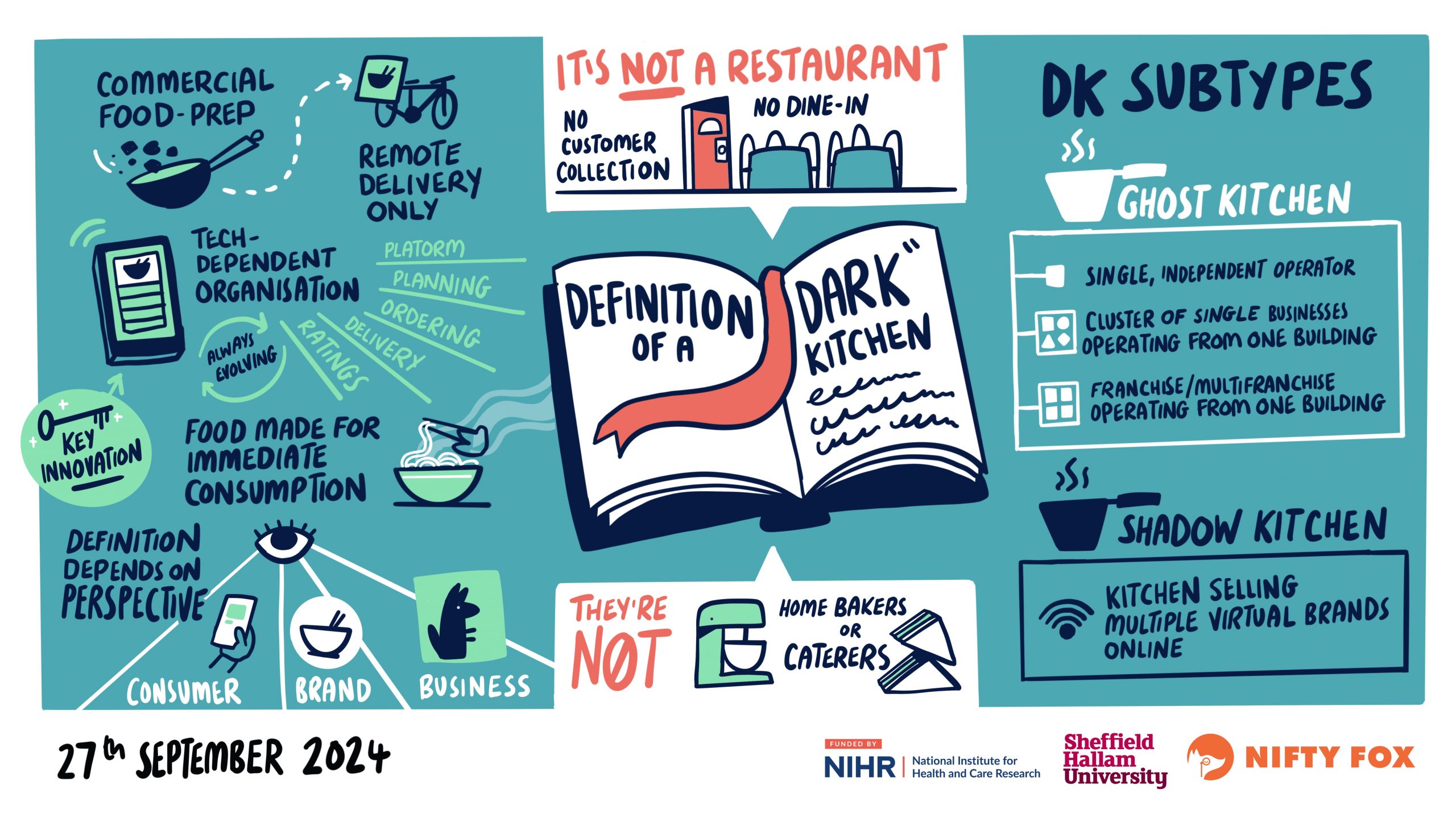
The purpose of this graphic is to visually represent the decision-making process that a research team alongside an expert group of stakeholders undertook to develop a definition of dark kitchens in a UK context.
‘Dark retailers’, including dark kitchens, largely proliferated during the COVID-19 pandemic, and are more prevalent in urban areas, and areas of deprivation (Huang et al., 2025), potentially leading to health inequalities. Research suggests that dark kitchens account for 15.9 per cent of all food outlets that are found on online food delivery platforms (Huang et al., 2025).
Dark kitchens are a contemporary addition to the food environment (Jia et al., 2024; Keeble et al., 2023), but there is no clear data on their proliferation (Bradford et al., 2024; Xiang et al., 2023), and no agreed definition of what exactly constitutes a dark kitchen. This makes it difficult for local authorities who are responsible for identifying, surveilling and regulating food outlets, as the type of food outlet may determine the most appropriate processes.
Many local authorities do have local public health policy arrangements which affect planning decisions at-place, for the physical food environment. For example, so-called ‘takeaway management (‘exclusion’) zones’ may preclude the opening of new hot food takeaway outlets within 400-600m of a school or educational setting. Evidence to date shows that these exclusion zones do reduce the proliferation of new takeaways (Rahilly et al., 2024) and in turn, reduce childhood obesity levels (Xiang et al., 2024). However, the digital food environment, including dark kitchens, has the potential to override positive public health agendas in the physical food environment by providing easier access to food delivery to places of work, social settings and peoples’ homes.
Section 97 of the recently amended National Planning Policy Framework (Ministry of Housing, Communities and Local Government, 2024) states that:
Local planning authorities should refuse applications for hot food takeaways and fast food outlets:
a) within walking distance of schools and other places where children and young people congregate, unless the location is within a designated town centre; or
b) in locations where there is evidence that a concentration of such uses is having an adverse impact on local health, pollution or anti-social-behaviour.
However, there is a lack of recognition of the role of digital food brands, dark kitchens and the wider digital food environment infrastructure, and no suitable regulation is currently in place.
Dark kitchens may contribute towards inequalities at place, due to the provision of largely energy-dense, high fat, salt and sugar foods which can impact the prevalence of obesity and wider determinants of health. Dark kitchens are of a particular concern as they can rapidly produce high volumes of food, with a wide delivery radius, and tailored to the local population. For example, there may be over 15 ‘virtual brands’ operating from one single location (Huang et al., 2025) where each brand is targeting a different population group (i.e., price-conscious adolescents, time-poor families). Therefore, it is important that local authorities know where their dark kitchens are and whether there is growth in the dark kitchen sector. Without a standard definition, or process of identifying dark kitchens, local authorities are unable to understand and measure the impact of dark kitchens on public health.
This graphic demonstrates the complexity of factors which were considered in the development of a definition of dark kitchens. The work consolidated the viewpoints of a diverse group of stakeholders consisting of academics, local authority partners working in public health, environmental health, planning and trading standards, dark kitchen food industry and national food bodies. Key unique attributes of dark kitchens were identified via a process of consultation to understand the most effective ways that dark kitchens could be characterised to improve local authority monitoring and measuring, and to determine a robust, cross-sectoral, consensus definition.
The final definition is, ‘Technology-enabled commercial kitchen(s) operating primarily for delivery, to fulfil remote, on demand, consumer online orders of food for immediate consumption’ (Nield et al., 2025), and suggested benefits of implementing the definition for different stakeholders are made in the published paper.
This graphic has been produced by Nifty Fox, a live scribe agency, who was commissioned to work on this project and provide an illustrative understanding of the decision-making processes undertaken by the research teams. The full slide set can be found here: https://niftyfoxcreative.pixieset.com/darkkitchens/. The series of images have been used widely to demonstrate the complexity of achieving a consensus definition for dark kitchens, and have allowed the research team to communicate this complexity to a number of different audiences in an engaging and inclusive way.
Lucie Nield, Sheffield Centre for Health and Related Research (SCHARR), Division of Population Health, School of Medicine and Population Health, Regent Court, 30 Regent Street, Sheffield, S1 4DA. Email: l.nield@sheffield.ac.uk
Bradford, C.P.J., O’Malley, C.L., Moore, H.J., Gray, N., Townshend, T.G., Chang, M., Mathews, C., & Lake, A.A. (2024). ‘Acceleration’ of the food delivery marketplace: Perspectives of local authority professionals in the North-East of England on temporary COVID regulations. Nutr Bull, 49(2), pp. 180-188. CrossRef link
Huang, Y., Bishop, T.R.P., Adams, J., Cummins, S., Keeble, M., Rinaldi, C., Schiff, A., & Burgoine, T. (2025). Understanding the socio-spatial distribution of “dark retail” in England: Development of a unique retail location dataset. Health & Place, 94. CrossRef link
Jia, S.S., Raeside, R., Sainsbury, E., Wardak, S., Phongsavan, P., Redfern, J., Allman-Farinelli, M., Fernandez, M.A., Partridge, S.R., & Gibson, A.A. (2024). Use of online food retail platforms throughout the COVID-19 pandemic and associated diet-related chronic disease risk factors: A systematic review of emerging evidence. Obes Rev, 25(6). CrossRef link
Keeble, M., Adams, J., & Burgoine, T. (2023). Changes in Online Food Access During the COVID-19 Pandemic and Associations With Deprivation: Longitudinal Analysis. JMIR Public Health Surveill. CrossRef link
MHCLG (2024). National Planning Policy Framework. Ministry of Housing, Communities and Local Government (MHCLG). Available at: https://assets.publishing.service.gov.uk/media/67aafe8f3b41f783cca46251/NPPF_December_2024.pdf
Nield, L., Burgoine, T., Lake, A.A., Moore, H.J., Soon-Sinclair, J., Adamns, J., Bishop, T.R.P., Bowles, S., Boyland, E., Bradford, C., Chang, M., Cummins, S., Duffy, J., Ferris, I., Harness, D., Huang, Y., Laheri, Z., Lloyd, S., Martin, H., … Beaumont, J.D. (2025). What are ‘dark kitchens’? A consensus definition from public, local authority, business and academic stakeholders in the United Kingdom. Perspectives in Public Health. CrossRef link
Rahilly, J., Amies-Cull, B., Chang, M., Cummins, S., Derbyshire, D., Hassan, S., Huang, Y., Keeble, M., Liu, B., Medina-Lara, A., Mytton, O., Rogers, N., Savory, B., Schiff, A., Sharp, S. J., Smith, R., Thompson, C., White, M., Adams, J., & Burgoine, T. (2024). Changes in the number of new takeaway food outlets associated with adoption of management zones around schools: A natural experimental evaluation in England. Population Health, 26. CrossRef link
Xiang, H., Goffe, L., Albani, V., Akhter, N., Lake, A.A., & Brown, H. (2024). Planning policies to restrict fast food and inequalities in child weight in England: a quasi-experimental analysis. Obesity, 32(12), pp. 2345-2353. CrossRef link
Xiang, H., Goffe, L., Albani, V., Akhter, N., Lake, A.A., & Brown, H. (2023). Out-of-home food environment and the COVID-19 pandemic: an interrupted time-series analysis in England 2019–2021. SN Business & Economics, 3 (162). CrossRef link