
Abstract
Scotland’s move towards peat-free horticulture exposes a persistent gap between recognised policy intent and practical delivery. Drawing on qualitative evidence from sector engagement in Scotland (two workshops, follow-up interviews and site visits conducted from late 2024 to mid-2025), this article synthesises how evidence from the horticultural supply chain has been translated, or not translated, into policy action. Participants report broad support for eliminating peat alongside recurring constraints: higher costs of alternative media, uneven market demand, variable inputs and quality, crop-specific technical risks, gaps in accessible guidance and knowledge exchange, and uncertainty created by unclear regulatory timelines and limited incentives. Frustration is described both among early movers and among those waiting for clearer direction, reinforcing perceived inequity. Using concepts from policy learning, implementation research and sustainability transitions, the article argues that delay is explained less by a lack of technical options than by institutional inertia and multi-level governance misalignment across Scotland, the UK and wider regulatory frameworks.
The policy problem
Peat has long been a key component for growing medium in horticulture (Robertson, 1962), but its continued use is at odds with climate and conservation policies and goals of the Scottish Government. Peatland degradation through harvesting for the supply chain contributes to carbon emissions and biodiversity loss, prompting calls to phase out horticultural peat to meet climate targets (Alexander et al., 2008; Gruda et al., 2024; Koseoglu & Roberts, 2025). In Scotland, approximately 1000 ha is currently harvested for the horticultural supply chain (Scottish Government, 2023), and in 2022, the UK imported 560,000 cubic metres of peat (no data available for the proportion in Scotland), primarily from the Republic of Ireland and the rest of Europe, accounting for 60 per cent of all peat used in UK horticultural (Litterick et al., 2020; UK Government, 2023).
Scottish Government strategy documents and climate plans have voiced support for phasing out peat, and a public consultation, Ending the Sale of Peat in Scotland (Scottish Government, 2023), drew stakeholder views on potential bans. However, progress has been halting in Scotland’s horticultural industry (Koseoglu et al., 2021), reflecting an implementation gap between policy intent and outcome (Rosli & Rossi, 2014; Nilsen, 2015). It should be noted that this progress has not been hindered by a lack of knowledge on alternatives to peat-based growing media (Gruda, 2019; Litterick et al., 2020; Prasad et al., 2023; Koseoglu & Roberts, 2025; Litterick et al., 2025; Macdonald & Everett, 2026).
This study focuses on the critical interface between industry stakeholders and policy mechanisms in Scotland’s peat-free transition. Through a series of stakeholder workshops and interviews (Macdonald & Everett, 2026) to identify barriers and co-develop solutions for eliminating peat in horticulture, industry participants, including growers, growing media producers, retailers, and industry experts, voiced strong support for moving away from peat, yet also highlighted numerous practical and economic hurdles. They put forward a range of recommendations for government and regulators to ease the transition. Many of these recommendations have not yet been reflected in policy, even as UK Government and devolved administrations debate peat ban timelines, originally set to be banned in 2024 (UK Government, 2022). This disconnect raises important questions about policy learning and responsiveness:
- Why, despite clear stakeholder consensus, have policies been slow to adjust?
- What prevents the Scottish Government from aligning regulations and support with industry needs?
This paper also considers the role of policy learning, to understand whether government has truly absorbed lessons from past failures and the extensive knowledge gained from multiple stakeholder engagement in Scotland (Scottish Government, 2023; Koseoglu & Roberts, 2025; Macdonald & Everett, 2026) or whether only superficial policy decisions could be made without addressing the needs of the industry. The application of policy learning theory seeks to examine why strong stakeholder consensus and extensive evidence (Scott et al., 2019), in the context of peat-free horticulture, has not translated into decisive policy action in Scotland. Policy learning theory focuses on how governments absorb, interpret, and apply knowledge generated through consultation, evidence gathering, and previous policy experience (Zaki, 2024) and provides a useful framework for understanding the inertia of policy makers in Scotland to the peat-free transition in horticulture. It is particularly relevant to sustainability transitions, where implementation often depends not only on technical solutions, but also on whether institutions are capable of adapting policy frameworks in response to emerging evidence and stakeholder needs (Tomai et al., 2024).
In the case of peat-free horticulture, the issue is not a lack of industry knowledge or willingness to change, but the limited translation of this knowledge into coordinated and responsive policy measures. By applying policy learning theory, the paper analyses how institutional fragmentation, governance misalignment, and risk-averse policymaking contribute to policy inertia despite broad agreement on the direction of change. By situating Scotland’s peat policy inertia in these theoretical contexts, the paper aims to discuss the complexities behind the limited translation of industry needs into policy action.
Evidence base
This analysis is based on the ‘Transition to Peat Free Horticulture’ report (Macdonald & Everett, 2026), which adopted a qualitative, case-study approach focused on Scotland’s peat-free horticulture initiative. The data was obtained from a stakeholder engagement exercise carried out between late 2024 and mid-2025 (Macdonald & Everett, 2026) using a semi structured interviews and structured facilitation workshops process. This approach combed breakout discussions on technical challenges of peat-free media (crop-specific issues and research needs), economic barriers (costs and supply chain constraints), knowledge and training gaps, and policy and regulatory alignment. Facilitators took detailed notes and a short pre-workshop survey gathered baseline information on current peat use and main concerns. In addition to the workshops, the project conducted semi-structured interviews with stakeholders selected to ensure representation of different subsectors and viewpoints in early 2025. A total of 22 interviews were conducted across the horticultural supply chain (detailed in Macdonald & Everett, 2026). These interviews explored issues that emerged in the workshops, including challenges faced by niche sectors and the perspective of retail chains on peat-free product supply. The project also undertook site visits to two nurseries to observe peat-free trials in progress. All data were analysed using a thematic analytic approach. A full methodology is detailed in Macdonald & Everett (2026).
Barriers to a peat-free transition
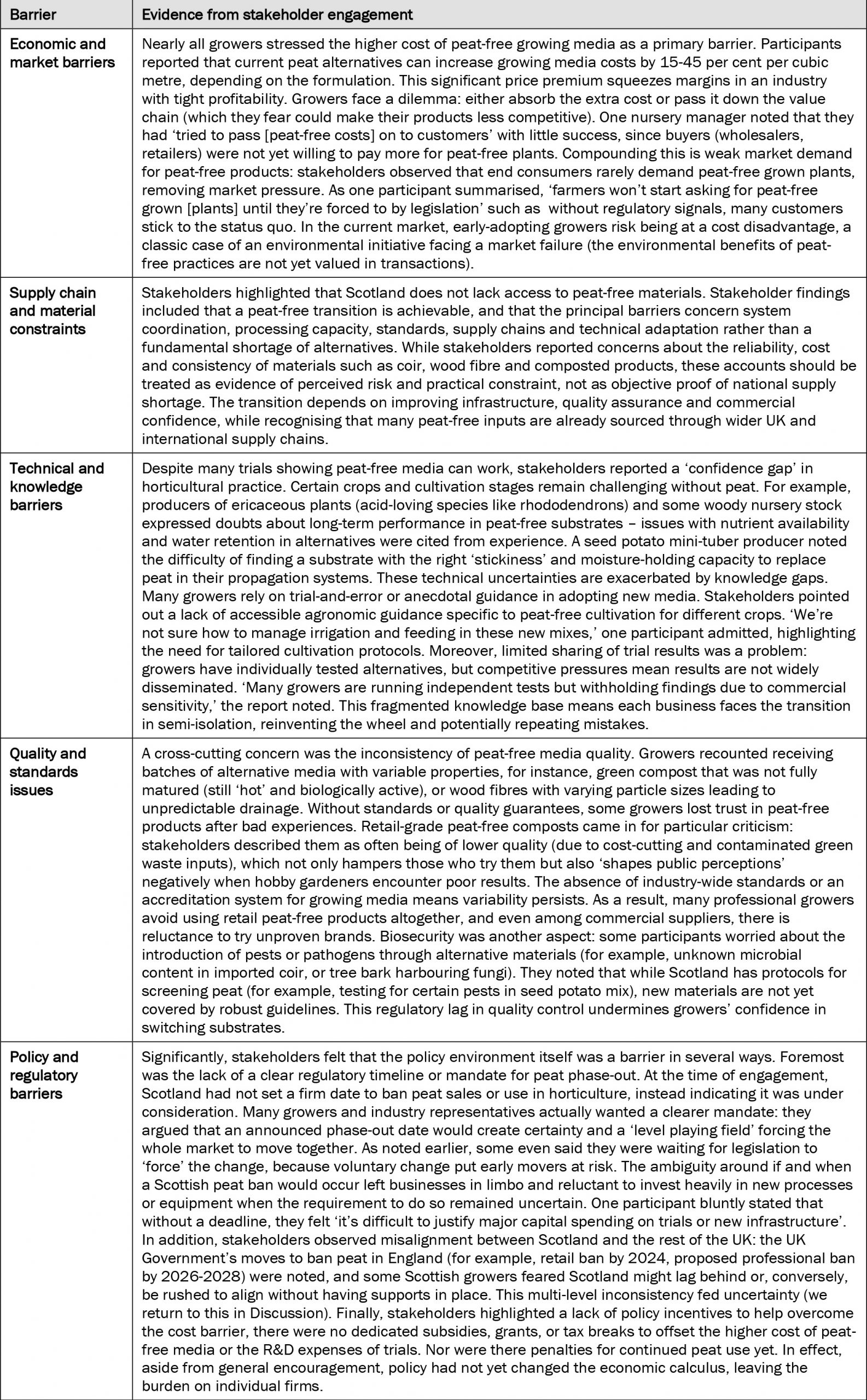
Three key areas were identified by stakeholders that required discussion and integration into the framework for the transition to peat-free horticultural supply chains in Scotland. This included i) the barriers to adoption that face the supply chain in moving to peat-free horticulture; ii) Stakeholder proposals for bridging the gap between need and policy, and iii) the perceived challenges between stakeholder insights and policy response (Table 1).
In summary, the industry recognises a confluence of economic, technical, and institutional challenges that slow the peat-free transition. These barriers are interlinked; higher costs and supply issues could be mitigated by government support or market signals; technical and knowledge gaps could be closed by coordinated research and advisory services; unclear policy direction could be resolved by decisive regulation. Stakeholders recognised these linkages, which informed their proposals for action.
Table 1: Barriers identified in stakeholder engagement
Bridging the gap between need and policy
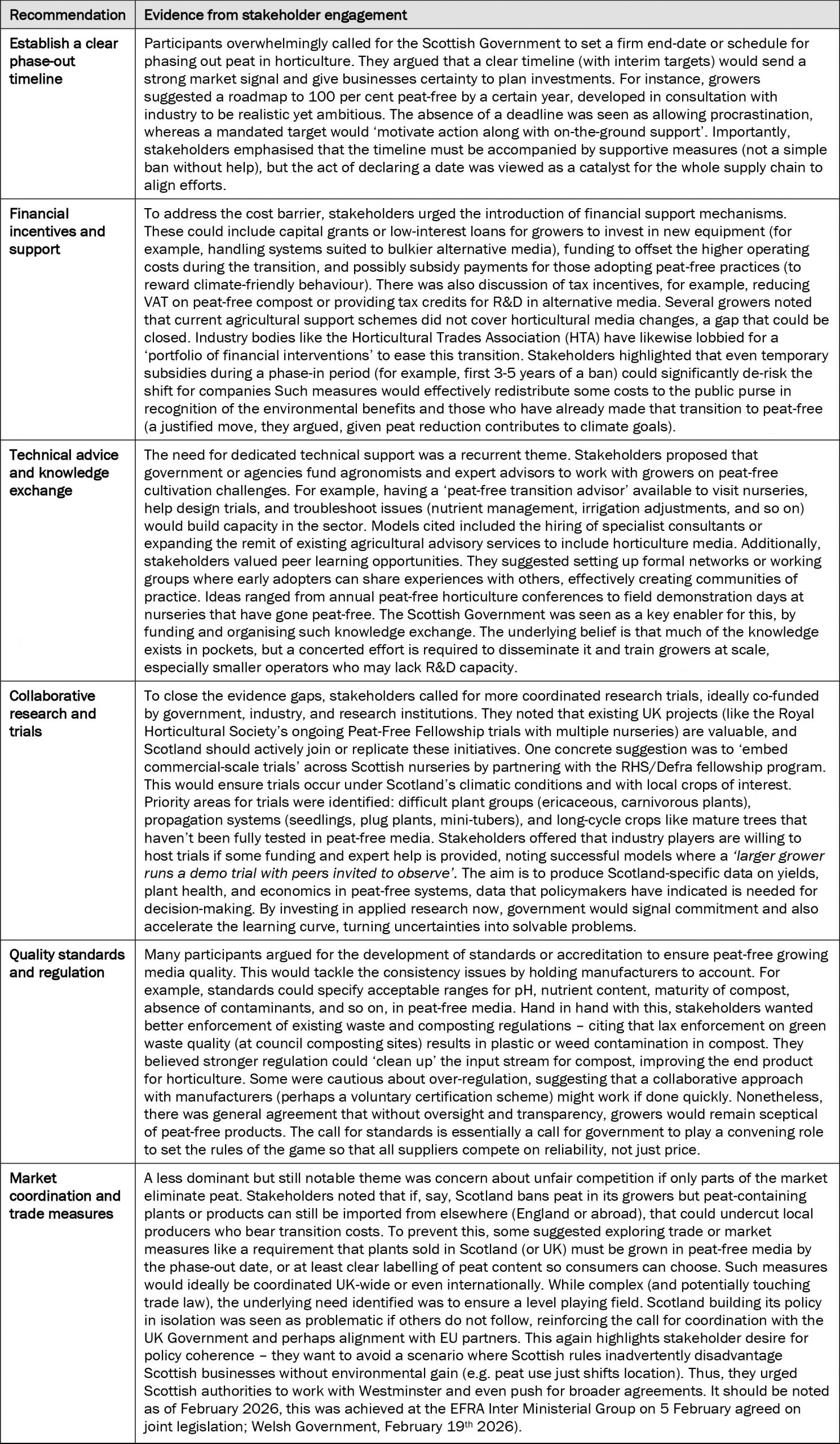
A key outcome of the engagement was a consistent set of recommendations from multiple stakeholders about what measures would facilitate a successful transition. Notably, these proposals directly target the barriers above, suggesting pathways to translate needs into effective policy (Table 2).
The stakeholder recommendations form an integrated package including clear rules, economic incentives, knowledge support, quality assurance, and market safeguards. In essence, they envision a proactive governance approach that aligns policy instruments to systematically remove the barriers identified. It is notable that stakeholders were not resisting change in which many are asking for more assertive policy intervention, not less. As one industry representative put it, ‘Give us the direction and the tools, and we will get on with it.’ This sentiment underscores that the often-perceived dichotomy between regulation and industry interest does not hold here; the industry recognises that smart regulation and support would enable them to achieve sustainability goals that they cannot reach alone under current market conditions.
Table 2: Stakeholder proposals for bridging the gap between need and policy
Why policy has lagged
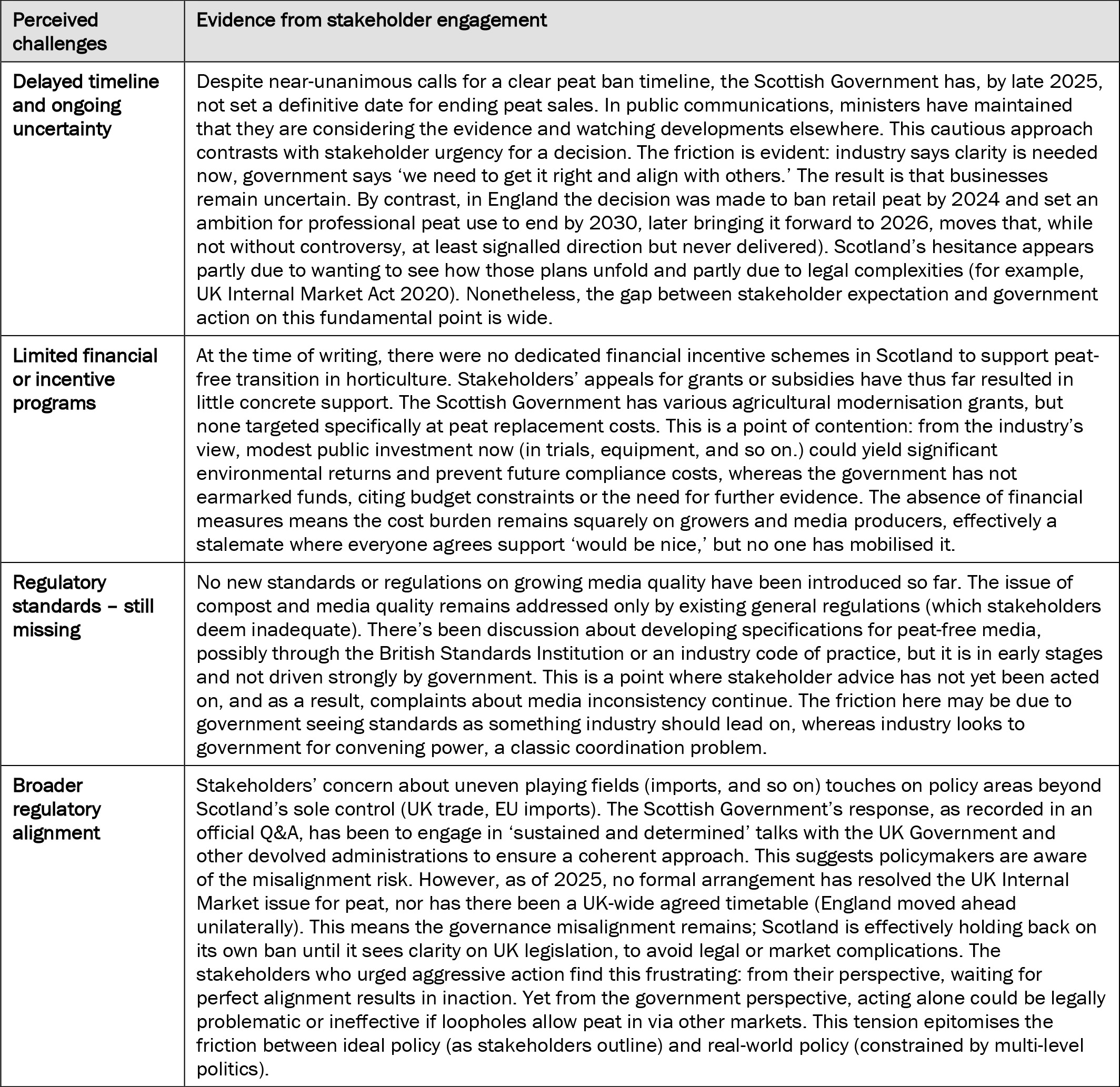
Given the above findings, there is a clear mismatch between stakeholder insights and the policy status quo as of 2026. There is a consensus that policy movement has been limited and slow, revealing a friction or lag in the uptake of insights previously provided.
The stakeholder engagement process provided a roadmap of solutions and whilst one alignment exists in principle, for example, the Scottish Government agrees with stakeholders on the end goal (peat elimination) and has acknowledged many of the same barriers in rhetoric. Where it falls short is in the urgency and decisiveness of measures. Industry representatives, seeing the ground realities, favoured an assertive package of reforms; officials have taken a more cautious, incremental stance. This divergence has led to a sense of policy inertia, despite evidence and consensus on what needs to be done including tangible changes on funding, regulation, and timelines remain pending. The following discussion seeks to assess why this inertia persists, exploring the structural and institutional reasons behind the gap between ‘knowing and doing’ in this sustainability transition.
Structural and institutional barriers to policy translation
Effective transitions require governments to learn from experience and new evidence, updating their strategies accordingly (Hocherman et al., 2025). In this context, genuine policy learning would mean the Scottish Government and regulators actively incorporating stakeholder knowledge and past policy outcomes (for example, the failures of voluntary peat reduction targets) into a fundamentally improved approach. The long reliance on voluntary measures by UK authorities, despite poor results, hints at a learning deficit, or an unwillingness to make decisions until last minute. Policy learning theory also highlights that who is involved in the learning process matters and that inclusive engagement can improve learning, but only if institutions are receptive and capable of translating insights into action (Zaki et al., 2024). Policy implementation can often fail due to the multiple areas of decision making involved and the multi actors involved (Enserink et al., 2022), as demonstrated in Scotland’s horticultural supply chain (Koseoglu & Roberts, 2025). In the case of peat-free horticultural policy where significant commitment to phase out peat has been made (Scottish Government, 2023), the process involves multiple agencies (environment, agriculture, industry, planning), each with its own priorities and potential requirements (Kern et al., 2019). Unclear responsibility or conflicting agendas between agencies (for example, climate policymakers versus agricultural support services) can stall progress and lead to policy inertia (Stål, 2015; Pearson, 2025). This is often rooted in such institutional frictions and the absence of strong accountability for implementation (Maedgen & Wlezien, 2024).
However, this research demonstrated that there is a strong knowledge base and consensus from across the horticultural industry and supply chain stakeholders. The failure to operationalise this knowledge is not from internal conflicting agendas from the horticultural sector, but a failure at institutional level to not just engage, but to use this knowledge to shape the strategy that will ultimately lead to the policy for peat-free horticulture. In short, the horticultural industry in Scotland knows what needs to be done and what resources are needed to make the transition, but structural and institutional barriers fail to translate and integrate this with decisions making.
Table 3: Perceived challenges between stakeholder insights and policy response
Conclusion and policy implications
Scotland’s move toward peat-free horticulture offers a key case of the hurdles in turning sustainability ambitions into reality. Through an in-depth examination of stakeholder engagement (Macdonald & Everett, 2026) and the examination of broader policy (non)responses, this paper has highlighted a pronounced implementation gap, in which the horticultural industry, by and large, is willing to change and has articulated clearly what it needs to do so, yet policy mechanisms have not yet delivered those needs. Barriers identified – from cost and supply constraints to knowledge gaps and regulatory ambiguities – are not merely technical issues but symptoms of deeper structural and institutional problems. These include an inertia in governance systems accustomed to incremental change, misalignments between different layers and arenas of policy (Scottish vs UK vs EU, environmental vs economic policy), and a risk-averse political culture when it comes to intervening in markets.
This critical analysis, informed by industry engagement, suggests that policy inertia in this case is rooted in both institutional paralysis and governance misalignment. The institutional paralysis is evident in how slowly the government apparatus has moved despite mounting evidence and stakeholder pressure, a typical policy response when new ideas confront old routines (Kern et al., 2019). Governance misalignment is seen in the need to coordinate multiple authorities and policy domains, a coordination that has lagged behind, leaving Scotland in a holding pattern to avoid clashing rules. These findings resonate with wider observations in sustainability transitions that achieving change requires not just innovating on the ground but also innovating in governance. Without adaptive governance that can integrate learning and align actors, even the best technical solutions may stall.
Policy implications
From a practical standpoint, the evidence implies a few crucial steps:
1) Set the course with clear policy signals
The time for hedging on a peat phase-out date should end. A clear, Scotland-specific timeline with defined dates (even if coordinated with the rest of the UK, it should be announced proactively) would eliminate the current uncertainty that hampers investments. It would also allow aligning support measures to milestones (for example, X% reduction by 2027 with corresponding subsidies, full phase-out by 2030). The stakeholder engagements findings show industry expects and can handle a deadline if given one. Policy learning here means trusting the stakeholder feedback that clarity will breed action, whereas ambiguity breeds delay.
2) Align governance and overcome fragmentation
The Scottish Government should establish a dedicated Peat-Free Transition group, bringing together the relevant departments (environment, agriculture, enterprise, waste) and engaging UK counterparts. This body’s mandate would be to implement the transition plan holistically, cutting through silos. It should also engage with the UK Government to resolve Internal Market concerns, for example, negotiating a peat products exclusion from UKIMA, which is possible if agreed politically. Engaging the other devolved nations might help create a unified front to push Westminster on this technical but crucial point. In the EU context, Scotland (via the UK or its own networks) can support calls for EU-level restrictions, which ultimately would benefit all by preventing leakage. These governance actions are about aligning rules and responsibilities so that stakeholder-driven solutions are not thwarted by jurisdictional issues.
3) Institutionalise support and standards
On the domestic front, Scotland can and should roll out the support package stakeholders asked for, rather than more pilot projects. This means real money on the table (even modest funds could have high leverage in this small sector) for grants and advice. It also means working with industry to set quality benchmarks for peat-free media. For instance, a government-endorsed certification for ‘Approved Peat-Free Growing Media’ could be launched, developed by scientists and industry reps, giving growers confidence that certified products meet certain criteria. This directly addresses the quality and trust issues. Such measures show government acting as a facilitator and regulator in tandem – a mix of carrot and stick that transition theory suggests is needed to destabilise old regimes and scale niches (Kern et al., 2019). Put simply, government must move from observer to enabler and enforcer.
4) Embrace reflexivity and continuous learning
The process is not one-off, as the transition unfolds, new challenges will emerge. Thus, the governance approach should be one of reflexive policy-making: regularly revisiting and adjusting strategies based on feedback from the ground (the exact opposite of a ‘set and forget’ regulation). This could involve annual reviews of peat reduction progress with stakeholder panels, adapting support programs if certain barriers persist (for example, if a particular alternative proves problematic, directing R&D there). By institutionalizing a learning loop (e.g. a formal advisory council on peat-free transition that remains in place through 2030), Scotland can avoid stagnation and show adaptive capacity. In essence, stakeholders should continue to have a voice in implementation, not just in initial consultation, ensuring the policy stays aligned with real-world dynamics.
Conclusions
Effective transitions require governments to learn from experience and new evidence, updating their strategies accordingly (Hocherman et al., 2025). In this context, genuine policy learning would mean the Scottish Government and regulators actively incorporating stakeholder knowledge and past policy outcomes (for example, the failures of voluntary peat reduction targets) into a fundamentally improved approach. The long reliance on voluntary measures by UK authorities, despite poor results, hints at a learning deficit, or an unwillingness to make decisions until last minute. Policy learning theory also highlights that who is involved in the learning process matters and that inclusive engagement can improve learning, but only if institutions are receptive and capable of translating insights into action (Zaki et al., 2024). Policy implementation can often fail due to the multiple areas of decision making involved and the multi actors involved (Roelich & Giesekam, 2019; Enserink et al., 2022), as demonstrated in Scotland’s horticultural supply chain (Koseoglu & Roberts, 2025). In the case of peat-free horticultural policy where significant commitment to phase out peat has been made (Scottish Government, 2023), the process involves multiple agencies (environment, agriculture, industry, planning, business and trade), each with its own priorities and potential requirements (Kern et al., 2019). Unclear responsibility or conflicting agendas between agencies (for example, climate policymakers versus agricultural support services) can stall progress and lead to policy inertia(Stål, 2015; Pearson, 2025). This is often rooted in such institutional frictions and the absence of strong accountability for implementation (Maedgen & Wlezien, 2024).
However, this research demonstrated that there is a strong knowledge base and consensus from across the horticultural industry and supply chain stakeholders. The failure to operationalise this knowledge is not from internal conflicting agendas from the horticultural sector, but a failure at institutional level to not just engage, but to use this knowledge to shape the strategy that will ultimately lead to the policy for peat-free horticulture. In short, the horticultural industry in Scotland knows what needs to be done and what resources are needed to make the transition, but structural and institutional barriers fail to translate and integrate this with decisions making. In conclusion, the case of peat-free horticulture in Scotland demonstrates that bridging the gap between knowing and doing in sustainability transitions requires critical self-examination of governance. It is not enough to have the science, technology, or even industry willingness; policy systems themselves must evolve. They must learn faster, coordinate better, and be willing to deploy new tools when old ones fail. The Scottish Government, along with UK partners, has an opportunity to turn what has been a slow, friction-laden process into a success story of transition, but only if it addresses the structural barriers identified. The environmental stakes (climate mitigation, peatland protection) and the timeline (net-zero commitments looming) make this not just an issue of horticultural practice, but of credibility in climate action. As our analysis shows, the answers are at hand, voiced by those on the frontlines. A more ambitious, coherent policy effort, grounded in theoretical insights and empirical evidence, can ensure that stakeholder engagement was not in vain but rather the foundation of a robust transition to peat-free horticulture in Scotland.
The author would like to thank Robyn Macdonald (RBGE) and Sally Nex (Plant Life UK) for final comments on this manuscript.
Dr Rosie Gearey is an environmental social scientist committed to advancing methodologically innovative research with real-world policy relevance, particularly in the context of sustainability and nature-based solutions.
This work was supported by ClimateXChange under grant reference ‘transition to peat-free horticulture’.
Rosie Gearey, Department of Rural Economy, Scotland’s Rural College, Edinburgh, EH93JG. Email: Rosie.everett@sruc.ac.uk
Alexander, P. D., Bragg, N. C., Meade, R., Padelopoulos, G., & Watts, O. (2008). Peat in horticulture and conservation: The UK response to a changing world. Mires and Peat, 3, Article 8. CrossRef link
Enserink, B., Thissen, W., Ruijgh, T., Kwakkel, J., Koppenjan, J., Kortmann, R., Hermans, L., van Daalen, E., Bots, P. & Slinger, J. (2022). Policy analysis of multi-actor systems. TU Delft OPEN Publishing.
Gruda, N. S. (2019). Increasing sustainability of growing media constituents and stand-alone substrates in soilless culture systems. Agronomy, 9(6), 298. CrossRef link
Gruda, N. S., Hirschler, O., & Stuart, J. (2024). Peat reduction in horticulture: An overview of Europe. Acta Horticulturae, 1391, 545–560. CrossRef link
Hocherman, T., Trop, T. & Ghermandi, A. (2025). Time lags in environmental governance: A critical review. Ambio, 54(12), 2042-2059. CrossRef link
Kern, F., Rogge, K. S., & Howlett, M. (2019). Policy mixes for sustainability transitions: New approaches and insights through bridging innovation and policy studies. Research Policy, 48(10), 103832. CrossRef link
Koseoglu, N., & Roberts, M. (2025). Supply chain dynamics of moving from peat-based to peat-free horticulture. Sustainability, 17(13), 6159. CrossRef link
Koseoglu, N., Roberts, M. & Bacigalupo, A. (2021). Understanding the barriers and opportunities for eliminating peat from the growing media mixes from the perspective of different supply side stakeholders. https://www.hutton.ac.uk/sites/default/files/files/publications/Understanding-Barriers-Opportunities-Peat-Growing-Media-Supply-Side.pdf
Litterick, A., Bell, J., Sellars, A., & Carfrae, J. (2020). Rapid evidence assessment of the alternatives to horticultural peat in Scotland. ClimateXChange. https://www.climatexchange.org.uk/wp-content/uploads/2023/09/rapid-evidence-assessment-of-the-alternatives-to-horticultural-peat-in-scotland.pdf
Litterick, A. M., Holmes, S., Frederickson-Matika, D. E., & Green, S. (2025). How safe are peat-free growing media? An exploration of plant pathogen risks to the horticultural industry and recommendations for risk mitigation. Plants, People, Planet, 7(6), 1684–1699. CrossRef link
Macdonald, R., & Everett, R. (2026). Transition to peat-free horticulture in Scotland. ClimateXChange. https://www.climatexchange.org.uk/publications/the-transition-to-peat-free-horticulture-in-scotland/
Maedgen, J., & Wlezien, C. (2024). Institutional friction and policy responsiveness: The puzzle of coalitional fragmentation and executive-legislative balance. Political Research Quarterly, 77(4), 1262-1278. CrossRef link
Nilsen, P. (2015). Making sense of implementation theories, models, and frameworks. Implementation Science 10 (53-79). CrossRef link
Pearson, M. (2025). Explaining climate change policy inertia: Policymaker perspectives on building energy efficiency in the United Kingdom. Energy Research & Social Science, 127, 104243. CrossRef link
Prasad, R., Redmile-Gordon, M., Gush, M.B., & Griffiths, A. (2023). Characterisation of peat-free growing media to facilitate the transition to peat-free horticulture. International Symposium on Growing Media, Compost Utilization and Substrate Analysis for Soilless Cultivation 1389 (pp. 153-162). CrossRef link
Robertson, R.A. (1962). Peat: its origin, properties and use in horticulture. Scientific Horticulture, 16, 42-51.
Roelich, K., & Giesekam, J. (2019). Decision making under uncertainty in climate change mitigation: introducing multiple actor motivations, agency and influence. Climate policy, 19(2), 175-188. CrossRef link
Rosli, A., & Rossi, F. (2014). Explaining the gap between policy aspirations and implementation: The case of university knowledge transfer policy in the United Kingdom. Industry and Higher Education, 28(6), 475-488.
Scott, T.A., Thomas, C.W. & Magallanes, J.M., (2019). Convening for consensus: Simulating stakeholder agreement in collaborative governance processes under different network conditions. Journal of Public Administration Research and Theory, 29(1), 32-49. CrossRef link
Scottish Government. (2023). Ending the sale of peat in Scotland: Consultation. Scottish Government. https://www.gov.scot/publications/ending-sale-peat-scotland-consultation/
Stål, H.I., (2015). Inertia and change related to sustainability–An institutional approach. Journal of Cleaner Production, 99, 354-365. CrossRef link
Tomai, M., Ramani, S.V. & Papachristos, G. (2024). How can we design policy better? Frameworks and approaches for sustainability transitions. Sustainability, 16(2), 690. CrossRef link
UK Internal Market Act (2020). https://www.legislation.gov.uk/ukpga/2020/27/contents
UK Government. (2022). Government response to the consultation on banning the sale of peat and peat-containing products in the amateur sector in England and Wales. Department for Environment, Food and Rural Affairs. https://consult.defra.gov.uk/soils-and-peatlands/endingtheretailsaleofpeatinhorticulture/
UK Government (2023). Impact of a proposed ban of the sale of horticultural peat in England. https://www.gov.uk/government/publications/report-impact-of-a-proposed-ban-of-the-sale-of-horticultural-peat-in-england-on-the-effective-operation-of-the-uk-internal-market/impact-of-a-proposed-ban-of-the-sale-of-horticultural-peat-in-england
Welsh Government (February 2026). www.gov.wales/written-statement-inter-ministerial-group-environment-food-and-rural-affairs-meeting-5-february
Welsh Government. (2026, February 19). Written statement: Inter-Ministerial Group for Environment, Food and Rural Affairs meeting, 5 February 2026. https://www.gov.wales/written-statement-inter-ministerial-group-environment-food-and-rural-affairs-meeting-5-february
Zaki, B.L., Pattyn, V., & Wayenberg, E., (2024). Policymaking in an age of polycrises: Emerging perspectives. Policy Design and Practice, 7(4), 377-389. CrossRef link