
Enabled by positive investment signals, including housing deregulation and pension and mortgage market liberalisation, the PRS has re-grown significantly over recent decades in the UK and beyond. In Scotland it accounts for 13 per cent of stock and households (National Records of Scotland, 2025; Scottish Government, 2026).
This re-growth was driven by a large heterogeneous group of small-scale part-time landlords who tend to frame the PRS as an investment designed to produce income, capital growth, or both as part of an overall welfare strategy (Crook et al., 2009; Soaita et al., 2016; Watson, 2026). However, much remains unknown about these landlords (Gargano & Giacoletti, 2022; Hochstenbach, 2022; Watson, 2026) and the broader influences that have undergirded PRS investment and divestment decisions over time.
As the sector has grown, so too have concerns regarding its performance, especially with regards to affordability, exclusion, conditions and even criminality (Spencer et al., 2020). While the policy response has differed across the UK (Watson, 2025), the devolved nations have been subject to sustained legislative and regulatory developments which have fundamentally altered the policy signals and drivers that supported the sectors re-growth, compounded by wider structural and economic factors, such as a shift from a low to moderate interest rate environment.
In parallel, evidence has emerged, particularly in Scotland, of large numbers of small-scale landlords leaving the sector (Scottish Government, 2022, 2026), with growing concern that there are also fewer new sector entrants. While landlords leave for a myriad of reasons, policy signal changes have been shown to play a significant role (Watson, 2024; Watson & Bailey, 2021). This matters because the PRS plays a pivotal role in the Scottish housing system and shifts in investment patterns have implications for supply, affordability and access.
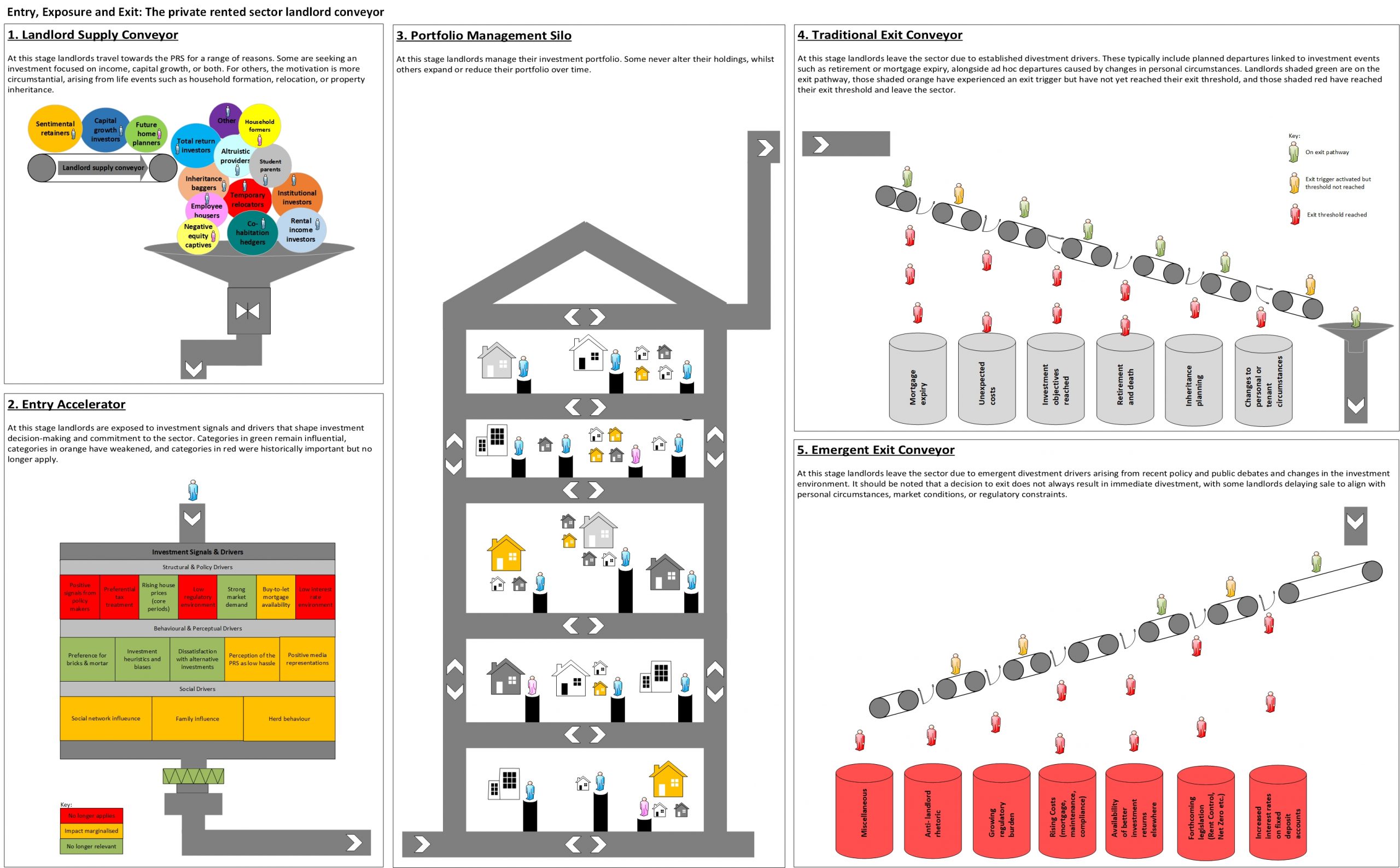
This graphic demonstrates why landlords enter the PRS and why they leave. It does so by conceptualising the phenomenon as a stylised industrial process. The first stage highlights the motivations and circumstances that lead landlords towards PRS investment. The second stage highlights the investment signals and drivers that influence landlord investment decision-making and underpin their commitment to sector investment. The factors highlighted in red were historically important but no longer apply, those in orange remain relevant but are weakened, and those in green continue to shape landlord decision-making.
The third stage highlights the landlord journey through the PRS. The directional arrows acknowledge that this journey is not linear; landlords may retain their initial portfolio size and investment strategy (e.g., targeted property type, tenant type etc.) throughout their holding period or may make alterations as their experience, circumstances and PRS investment appetite evolve.
The fourth stage highlights normative justifications for planned and unplanned landlord divestment from the sector. The fifth stage details emergent reasons for landlord departures, including those arising from recent policy and public debates and changes in the investment environment. Landlords begin the exit pathway in green. When their planned or unplanned exit threshold is reached, they turn red and exit the sector. Recognising that multiple cumulative reasons for exit may exist (Watson, 2024), landlords can also transition from green to amber before red when an individual exit trigger is activated but is insufficient to lead to immediate exit. A decision to exit does not always result in timely divestment, with some landlords delaying sale to align with personal circumstances, market conditions, or regulatory constraints.
This article draws on insights from three mixed methods research projects in Scotland comprising over 3,000 survey responses from landlords and 50 interviews with landlords and other PRS professionals (Watson, 2024; Watson & Bailey, 2021; Watson, 2023). The studies span a period of significant regulatory change (pre-, during and post pandemic) and increased public and political debate regarding the sector. While rooted in micro concerns about sector performance and macro concerns regarding the financialisation of housing, these debates have become increasingly rhetoric driven.
The graphic highlights the heterogeneity of landlords and the complexity associated with PRS investment decisions, revealing that the PRS is a dynamic system in which evolving public policy and macro-economic conditions shape investment signals and drivers. It also shows that investment signals have diminished from their historic peak. While landlords who continue to enter the sector may be more aware of these new norms, this marks a significant change to the investment landscape for many existing landlords and has led to emergent divestment drivers. This points to a need for policymakers to pay closer attention to PRS investment dynamics. By highlighting the pivotal role of behaviour and perception in framing PRS investment decisions, the graphic also points to opportunities for stabilising investment patterns through appropriate policy and behavioural interventions.
The stylised industrial process emerged iteratively through multiple drafts, which experimented with different layouts and visual components. All design work was carried out using Microsoft Visio Professional 2019.
Crook, T., Kemp, P., & Ferrari, E. (2009). Review of the Private Rented Sector: Volume 3: Views and experiences of landlords in the Private Rented Sector. Edinburgh www.webarchive.org.uk/wayback/archive/20180518193139/http://www.gov.scot/Publications/2009/03/23140128/24
Gargano, A., & Giacoletti, M. (2022). Individual Investors’ Housing Income and Interest Rates Fluctuations. SSRN Electronic Journal. CrossRef link
Hochstenbach, C. (2022). Landlord Elites on the Dutch Housing Market: Private Landlordism, Class, and Social Inequality. Economic Geography, 98(4), 327-354. CrossRef link
National Records of Scotland. (2025). Estimates of Households and Dwellings in Scotland, 2024. National Records of Scotland. https://www.nrscotland.gov.uk/publications/households-and-dwellings-in-scotland-2024/
Scottish Government. (2022). Number of landlords registered in Scotland. Response-202200329233. https://www.foi.scot/
Scottish Government. (2026). Housing statistics: Scottish Landlord Register data. https://www.gov.scot/publications/scottish-landlord-register-data/
Soaita, A. M., Searle, B. A., McKee, K., & Moore, T. (2016). Becoming a landlord: strategies of property-based welfare in the private rental sector in Great Britain. Housing Studies, 32(5), 613-637. CrossRef link
Spencer, R., Reeve-Lewis, B., Rugg, J., & Barata, E. (2020). Journeys in the Shadow Private Rented Sector. https://ch1889.org/journeyslaunch
Watson, A. R. (2023). Canny Investors? A mixed methods investigation into the investment behaviours of Scottish private rented sector landlords. (Thesis: Doctor of Philosophy), University of Glasgow.
Watson, A. R. (2024). The Challenges Faced by Rural Landlords: The case of Argyll and Bute. https://housingevidence.ac.uk/wp-content/uploads/2024/08/RURAL-LANDLORDS-DRAFT-V10.pdf
Watson, A. R. (2025). 2025 UK Housing Review Autumn Briefing Paper: Reforming the private rented sector: compliance and enforcement challenges https://www.cih.org/publications/2025-uk-housing-review-autumn-briefing-paper/
Watson, A. R. (2026). All of their eggs in one basket: portfolio neglect and intuitive accumulation among Scottish PRS landlords. International Journal of Housing Markets and Analysis, 1-23. https://doi.org/10.1108/IJHMA-10-2025-0253
Watson, A. R., & Bailey, N. (2021). The Pandemic Arrears Crisis: Private landlord perspectives on the cessation of the ‘eviction ban’. https://housingevidence.ac.uk/publications/the-pandemic-arrears-crisis/