
Abstract
Tenure insecurity, including eviction/landlord-ended tenancy and precarious tenure, has multiple social and health consequences. International research has identified a range of risk factors for insecure tenure, many of them consistent with other housing discrimination risks. This study used a 2018 population-weighted survey to compare likelihood of landlord-instigated tenancy end and frequency of moves across social and demographic groups in Aotearoa New Zealand. Non-heterosexuals, young adults, and households with no spare bedrooms had high levels of renting, and were in precarious tenure (high mobility, highly landlord-instigated). Pacific peoples, sole parents, and people with constrained finances also had high renting levels, and were reluctant movers (lower mobility, but highly landlord-instigated). Couples, adults 25 to 44 years, and ‘large urban’ dwellers had mixed renting levels, but were self-mobile (high mobility, by choice). No groups were tenure secure (low mobility, less landlord-instigated).Landlord-ended tenancy risks were generally consistent with previous international research, but ‘non-heterosexuals’ were a newly identified at risk group. Survey data were collected when ‘no cause’ notice was legal. Future research could investigate whether 2021 to 2024 law changes narrowing landlords’ legal reasons to end tenancies lowered the risk of landlord-ended tenancy for vulnerable groups.
Keywords: Tenure security; involuntary mobility; eviction; health determinants; housing discrimination.
Introduction
In this paper, we describe the demography of landlord-ended tenancies and precarious tenure, and identify risk factors for tenure insecurity in Aotearoa New Zealand (NZ) prior to 2021 legislation changes (described in Table 1). We used data from the Statistics NZ General Social Survey (‘the Survey’) to compare the likelihood of landlord-instigated tenancy end and frequency of moves across social and demographic groups in NZ. Non-heterosexuals, young adults, and households with no spare bedrooms had high levels of renting, and were in precarious tenure (high mobility, highly landlord-instigated). Pacific peoples, sole parents, and people with constrained finances also had high renting levels, and were reluctant movers (lower mobility, but highly landlord-instigated). Couples, adults 25-44 years, and ‘large urban’ dwellers had mixed renting levels, but were self-mobile (high mobility, by choice). Importantly, no groups were tenure secure (low mobility, less landlord-instigated).
These risk factors are important because tenure insecurity and precariousness add to the layers of barriers to equitable outcomes for people with limited social and financial resources. In order to develop policies to mitigate tenure insecurity – or when reinstating policies likely to exacerbate tenure insecurity – it is important to understand who these policies are most likely to affect. The findings here establish an important baseline for estimating the impact of 2021 legislation changes removing ‘no cause’ notice, and 2025 changes reinstating it; and are also potentially relevant to other countries moving to improve tenure security (Carr & Kirton-Darling, 2024).
In this paper we use the term landlord-ended tenancy rather than eviction for two reasons. First, eviction has a specific legal meaning in NZ, which we detail later in the paper. Second, because of eviction’s extreme circumstances, the terms eviction or evicted can carry stigma (Grainger, 2021). Tenants may be unwilling to describe themselves as having been evicted when they have left a tenancy in a routine way after the landlord has ended it. Respecting respondents’ right to define their own circumstances, we therefore describe tenancies ended by the landlord, rather than the tenant, as landlord-ended tenancies rather than eviction.
Background
Tenure insecurity, including eviction/landlord-ended tenancy and precarious tenure, is a social and public health issue (Desmond, 2016). Adverse consequences for tenants include not only the effects of actual involuntary move, such as disruption to children’s schooling, or the cost of a move; but also wide-ranging health effects (Bower et al., 2021; Hoke & Boen, 2021; Nathan et al., 2022; Smith et al., 2024), and the psychological (Carrere et al., 2022; Gillespie et al., 2020; Nathan et al., 2019; Pleasence & Balmer, 2008; Vásquez-Vera et al., 2021) and social (Collins et al., 2018) effects of precarious tenure. Tenants may be unwilling to establish community connections, or truly settle into a home, in case they must move again soon (Byrne & McArdle, 2022; Ong ViforJ et al., 2023; Soaita & McKee, 2019; Waldegrave & Urbanová, 2016). Each move requires learning how to manage a new indoor thermal environment (Serjeant et al., 2022), increasing cold and damp-mediated health risks in the interim (Riggs et al., 2021). Furthermore, tenants can also experience follow-on trauma from eviction, such as child maltreatment (Bullinger & Fong, 2021) or loss of identity and sense of home (Power, 2022). Likelihood of worse outcomes has been found to be higher for people whose reasons for housing insecurity are economic, compared to legal (Vásquez-Vera et al., 2022).
In NZ, risk factors for eviction have not been quantified. There is qualitative evidence of the effects of landlord-ended tenancy (Chisholm et al., 2022; Chisholm et al., 2017; Zwaan et al., 2017), particularly for older renters (James et al., 2020; James & Saville-Smith, 2016, 2018). Witten et al.’s 2017 study found 30 per cent of surveyed tenants gave the reason they had left their last tenancy as ‘landlord sold the house’, and two per cent as ‘was evicted’ (Witten et al., 2017), but that study did not assess risk factors for having the tenancy ended by the landlord, and some landlord-ended tenancies would have been categorised among the 11 per cent with ‘other’ reasons for move. One quantitative paper has shown that sexuality and gender diverse youth had experienced high rates of landlord-ended tenancy (56 per cent), and that it was significantly associated with having experienced homelessness (Fraser et al., 2022).
Renting in New Zealand
At the time the survey was conducted, roughly a third of NZ households rented their homes, with 83.5 per cent of tenants renting from private landlords, rather than public or community housing providers (Stats NZ, 2020). While 80 per cent of NZ landlords own only one property, the remaining 20 per cent own 73 per cent of private rentals (Bell, 2021). Forty percent of all private rentals are commercially managed (Ministry of Housing and Urban Development, 2022).
In 2018, most tenants (67.5 per cent) were on ‘periodic’ tenancy agreements, which have no fixed end date, rather than on fixed-term tenancies (29.7 per cent) (Stats NZ, 2020), which become periodic at the end of the fixed term unless both parties agree to a new fixed term, or unless one party ends the tenancy. Fixed terms appear to be most commonly one year (Landlords.co.nz, 2016; Moger, 2023; Quinovic, 2020; Stats NZ, 2020), though actual data on fixed term tenancy lengths are scant. Census data from 2018 showed nearly 40 per cent of tenants in private rentals had lived at their current residence less than a year; and less than 20 per cent had lived at their current residence for more than four years (Stats NZ, 2020). In 2019, the NZ Property Investors Federation reported the average tenancy duration amongst its members was two years, three months (Gibson, 2019).
This high mobility is likely to be connected to the legal framework governing tenancies, which has historically made it easy for landlords to end a tenancy with relatively short notice periods. At the time the Survey was conducted, legal grounds for a landlord to end a tenancy included sale of the property; the landlord or landlord’s family member wishing to move into the property; the landlord seeking a legal possession order due to overdue rent, damage to the property, or threatening behaviour by the tenant; a fixed-term tenancy having reached the end of its term; or simply landlord choice, with landlords entitled to give ‘periodic’ agreement tenants 90 days’ notice without providing any reason (Residential Tenancies Act, 1986), leaving all tenancy security subject to the goodwill of landlords. Table 1 summarises the legal grounds and notice periods for ending tenancies, before and after 2021 and 2025 legislation changes.
Table 1: Key legal grounds for landlords to end tenancies in NZ, and notice periods, before and after 11 February 2021 and 30 January 2025 legislation changes
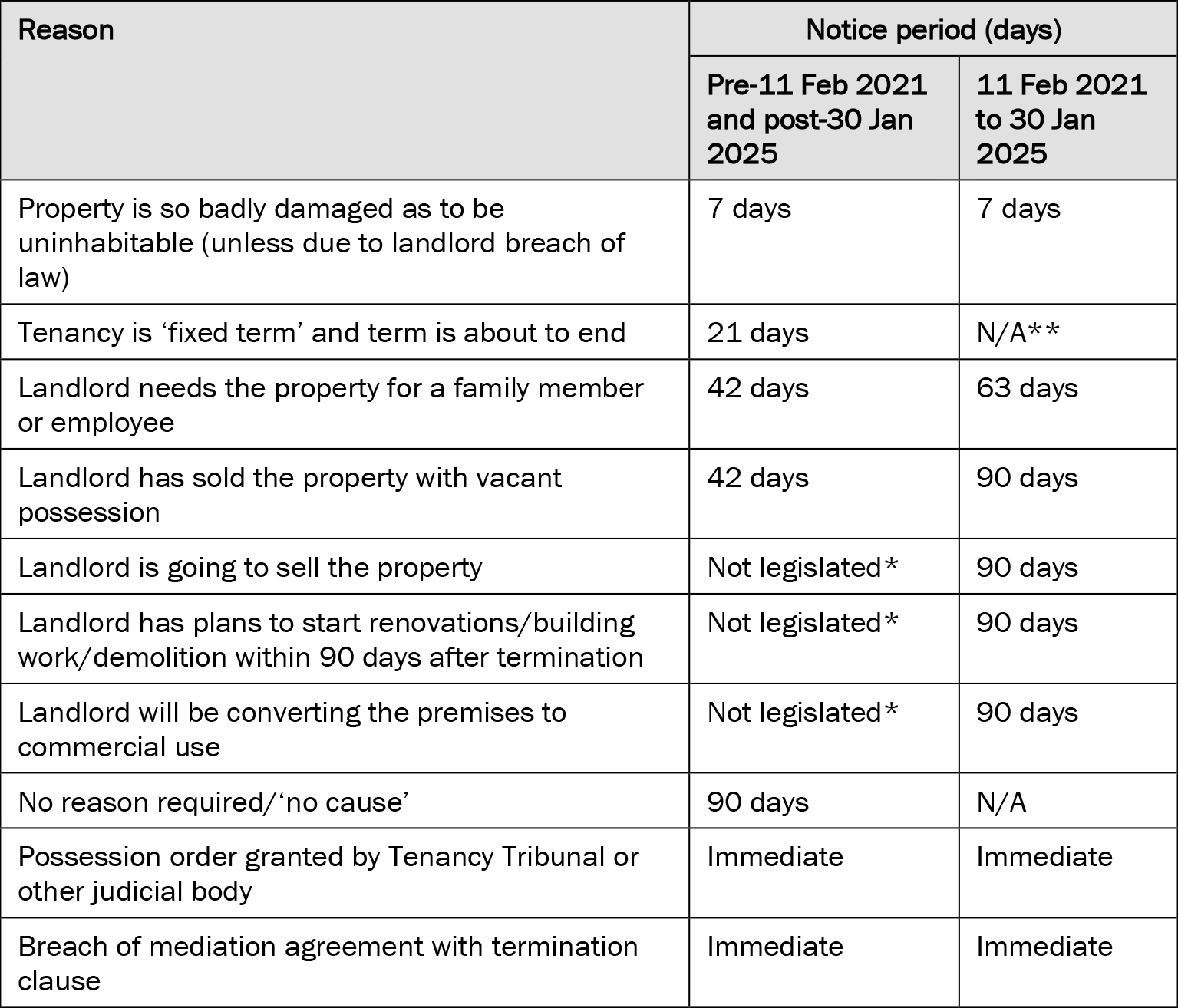
*In these or any other circumstances landlords could use the 90 day ‘no cause’ option.
** In this period, fixed term tenancies automatically became periodic at the end of a fixed term, and could only be ended for one of the other allowed reasons, with the matching notice period.
Tenancies can also end in other ways. A tenancy may be ended immediately when a court or tribunal grants ‘possession’ to the landlord because a tenant has not vacated at the end of a notice period or is otherwise in breach of their obligations, most commonly payment of rent (Toy-Cronin & Bierre, 2022); or when a tenant has breached a court mediation agreement with a termination clause. And, finally, there is eviction, which in NZ law is the act of physically removing the tenant and their belongings from the property and is the final legal step available to a landlord if the tenant remains in the property despite a possession order having been issued. As noted earlier, we use the term ‘landlord-ended tenancy’ throughout this paper to encompass all landlord-instigated tenancy endings, while recognising that in international literature, landlord-instigated tenancy end is categorised as ‘eviction’.
Risk factors for landlord-ended tenancy risk, and housing discrimination
Previous studies in high-income countries have found a range of demographic factors associated with increased risk of eviction. Tsai & Huang’s (2019) review identified four main risk factors for studies from the USA, Canada, the UK, and the Netherlands: financial hardship; sociodemographic characteristics such as larger households or having more children; gender (sometimes); and substance abuse and other health problems. Additional eviction risk factors identified in one or more of their reviewed papers could be loosely classified as demographic, socioeconomic, or health and social risks. Demographic risk factors were gender (though which gender was at risk varied by study); younger age; and being Black or Latino (but being of Asian ethnicity reduced risk). Socioeconomic risk factors identified were financial difficulties, job loss, number of people in the household, no high school education, and social network disadvantage. Health and social risks identified were mental illness, hoarding disorder, experience of violence, and neighbourhood crime (Tsai & Huang, 2019).
Other studies not included in Tsai and Huang’s review, carried out in Sweden (Stenberg et al., 1995), Australia (Beer et al., 2006), the Netherlands (Van Laere et al., 2009), and the USA (Friedman & Nakatsuka, 2021; Hobbs, 2021; Lochhead, 2021) had similar findings, or identified the following additional risk factors and at risk groups: receiving welfare benefits, involvement in crime (Stenberg et al., 1995), living alone, or being a solo parent, or older man (Beer et al., 2006). At a regional level, Kang (2021) also identified low car ownership as associated with higher eviction levels; while Merritt & Farnworth (2021) observed that ‘tenant-friendly’ policies can reduce state eviction rates and disparities.
Where eviction risk factors represent membership of a particular population group, they have also all variously been identified as risk factors for housing discrimination. Younger age, gender, ethnicity, health (including mental health) status, household size, having children, and being a survivor of violence (Lapidus, 2002; Ross, 2007), all appear in housing discrimination literature, along with sexual orientation, (Wilson et al., 2021) migrant status (Mensah & Tucker-Simmons, 2021), and having a disability (Aalberts, 1998). Most are also statuses against whom discrimination in the allocation of housing is prohibited under s21(1) of the NZ Human Rights Act 1993 (Soda et al., 1993). As we can see, housing discrimination and eviction are closely linked.
Like tenure insecurity, housing discrimination also has adverse health and psychosocial effects. Race- or ethnicity-based housing discrimination is the most widely explored, with a recent review listing the detrimental health or wellbeing effects of racialised housing discrimination as including pre-term birth, lower life satisfaction, psychological stress, increased mental illness, poor self-reported health, and uterine fibroids (Cross et al., 2023). Mental health and self-rated health are diminished by intersectional discrimination in housing (Lu et al., 2022). This is consistent with adverse health effects from discrimination on other grounds, and in other areas of life (Bastos et al., 2015; Sutter & Perrin, 2016). Housing discrimination, and landlord judgements of what constitutes a ‘good’ tenant can lead to eviction, particularly where regulation and protection of renters’ rights are minimal (Byrne & McArdle, 2022; Power & Gillon, 2022). These findings show the intersection between housing discrimination and eviction risk, and highlight the vulnerability of marginalised groups in the rental market.
Method
This paper draws on data from the 2018 iteration of Statistics NZ’s (Stats NZ) biennial General Social Survey. The core Survey is extensive, with 18 sections, and in 2018 included a ‘housing and physical environment’ supplement. Questions drawn on for this study cover the respondent’s age, sex, ethnicity, sexual orientation, location, household makeup, disability, employment status, economic indicators, crowding, current tenure and landlord sector, previous tenure, and main reasons for their last move (Stats NZ, 2018a).
The Survey interviewed 8,793 people aged 15 years and over, living in private dwellings of all tenures across NZ, over the period 1 April 2018 – 31 March 2019. One person from each selected household was interviewed, following a three-stage sample selection method designed to provide weighted national-level estimates. More details on the Survey methodology and reliability of survey estimates are available from Stats NZ Stats NZ, 2018b; Stats NZ, 2018c).
We accessed anonymised Survey responses in NZ’s Integrated Data Infrastructure (Stats NZ, 2021b). All measures used survey weights provided by Stats NZ. Analysis was carried out in StataSE 16.1. Additional descriptive data were sourced online from Stats NZ (Stats NZ, 2018d). Ethics approval for the study was granted by the University of Otago Human Ethics Committee HD23/043.
Sociodemographic and socioeconomic variables
Variables measured are shown in Table 3. Gender was collected as ‘male’ or ‘female’ and did not collect transgender or other gender identities. We assigned ethnicity as multiple response for Māori, Pacific Peoples, Asian Peoples, Other, and ‘MELAA’ (a Stats NZ composite group of Middle Eastern, Latin American and African); or to a residual ‘NZ European’ group, defined as non-Māori, non-Pacific, non-Asian, non-MELAA, non-Other. We assigned neighbourhood level socioeconomic deprivation quintile using NZDep2018 (Atkinson et al., 2020). Sexual orientation was collected as ‘heterosexual or straight; or ‘gay or lesbian’, ‘bisexual’, or ‘other’, which we aggregated to ‘not heterosexual’ due to sample size. We hope future research has sufficient data to disaggregate. We clustered ‘like regions’ by similarity of early univariate results and included them as much to control for, as to look for, regional variation. Urban classification was assigned using Statistics NZ’s ‘Urban rural indicator’ (Stats NZ, 2021a). Household crowding was measured using the Canadian National Occupancy Standard (Stats NZ, 2012). Participants were defined as having a disability if they answered ‘yes’ to any of a range of questions about visual impairment, hearing, mobility, mental faculties, self-care, and communication.
For each included demographic group and response variable, we measured three variables: likelihood households were currently renting; likelihood ‘the last tenancy was ended by the landlord’ for those previously renting; and ‘Mean Mobility Score’ for those currently renting.
Previously and currently renting, and sector of current landlord
Respondents were asked ‘I’d like you to think about the last place you lived before moving to your current address. Did you or your household pay rent for that house or flat?’ Those who responded ‘yes’ were classified as ‘previously renting’. Respondents were classified as ‘currently renting’ if they responded ‘yes’ to the question ‘Do you or anyone else who lives here, pay rent to an owner or agent for this house or flat?’
Mean Mobility Score
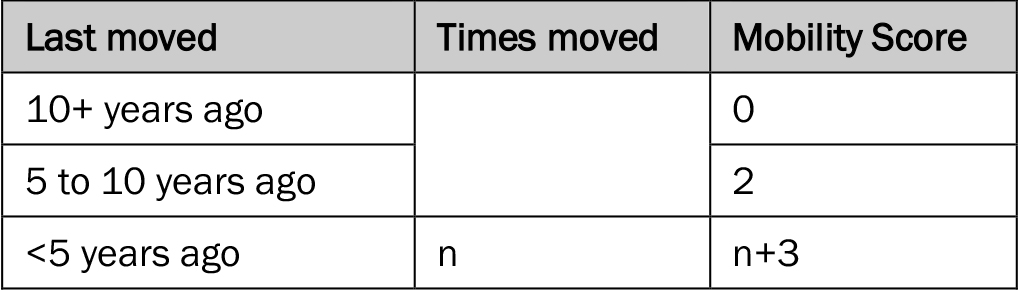
Mobility questions are shown in Figure 1. Survey respondents were assigned a mobility score as follows: last moved ten or more years ago=0; last moved five to ten years ago=2; otherwise = (times moved in last 5 years) + 3. These scores were assigned so that having moved more recently, and more often, resulted in a higher score, as illustrated in Table 2. Scores were then averaged across variable groups to create a Mean Mobility Score (Mobility Score, or MMS). A higher Mobility Score indicated people in the group were more mobile than people in groups with a lower Mobility Score.
Figure 1: 2018 General Social Survey mobility questions
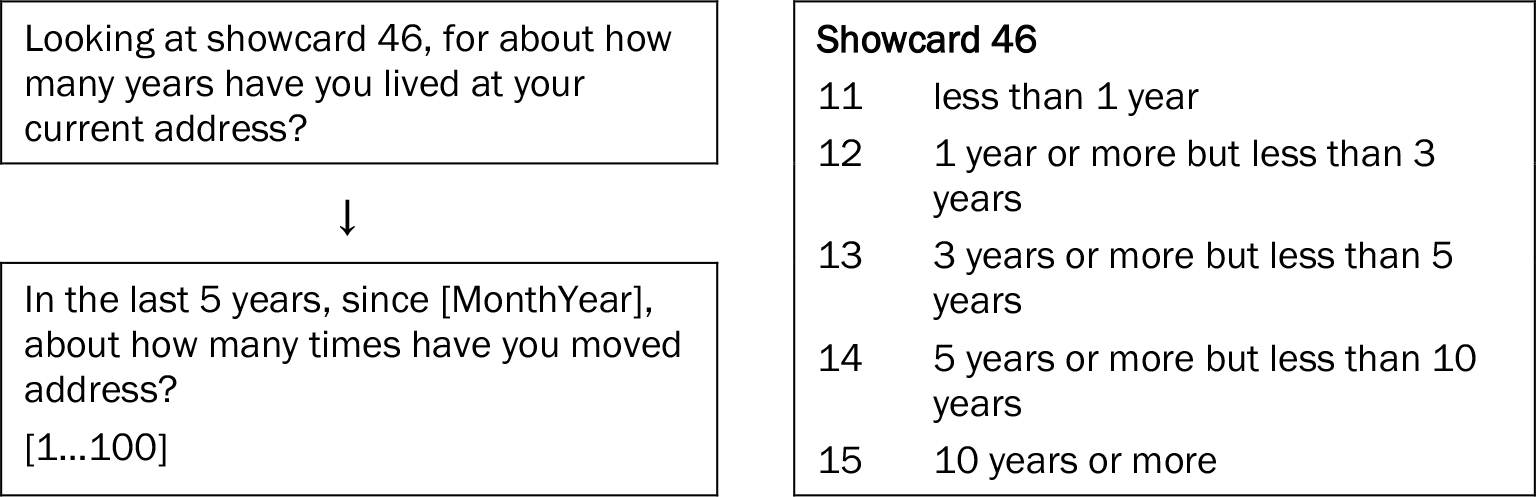
Table 2: Time since last moved, times moved, and assigned mobility scores
Landlord-Ended Tenancies
Respondents who were previously renting were asked the main reason they moved out. The range of coded responses is shown in Figure 2. Respondents who had answered ‘the tenancy was ended by landlord e.g. landlord sold house or flat, expiry of lease agreement’ were classified as having had ‘landlord-ended tenancies’ (LET).
Statistical analysis
We first calculated the percentage of respondents who were currently renting in any rental sector, whether previously renting or not (Figure 3 and ‘% Renting’ in Table 3), total and by sub-group. Next, we calculated percentages for the reasons previously renting respondents and continuing tenants (previously renting and also currently renting) had left their last tenancy (Figure 2), and then the percentage of previously renting respondents in each sub-group whose last tenancy had been ended by the landlord (Figure 4 and % LET in Table 3); and the Mean Mobility Scores for those currently renting (Figure 5 and MMS in Table 3).
Figure 2: 2018 General Social Survey reasons for moving from previous tenancy
![Surveyors asked respondents ‘Looking at showcard 48, what was the main reason you moved out of your previous address?’ Showcard 48 options were:
1. The tenancy was ended by landlord eg landlord sold house or flat, expiry of lease agreement
2. Moved from rental into own house or flat
3. Had a poor relationship with landlord
4. For social reasons e.g. to live closer to family / friends, relationship change
5. For education or work-related reasons
6. To move to a better quality home e.g. warmer, better maintained
7. To move to a more suitable home e.g. more accessible, better size
8. Housing costs too expensive / moved to a cheaper house or flat
9. For location reasons e.g. moved to be closer to services
10. Other – please state
11 Moved from another country [post-survey disaggregation]
12. Don’t know
13. Declined to respond
For respondents who were previously renting, the most common reason for moving was that they had moved from rental into their own house or flat (20%), followed by the tenancy having been ended by the landlord (17.6%). The least common reason was that the tenant had a poor relationship with the landlord. For continuing tenant respondents, the most common reason was that the tenancy had been ended by the landlord (25.4%), followed by ‘to move to a more suitable home’ (14.6 %); and the least common reason was moving from a rental into their own house or flat (1.6%). Apart from moving from a rental into their own home, and landlord ended tenancies, reasons for moving were loosely similar between those previously renting and continuing tenants. Results for ‘don’t know’ and ‘declined to respond’ were suppressed.](https://ppp-online.org/wp-content/uploads/2026/05/Figure-2.jpg)
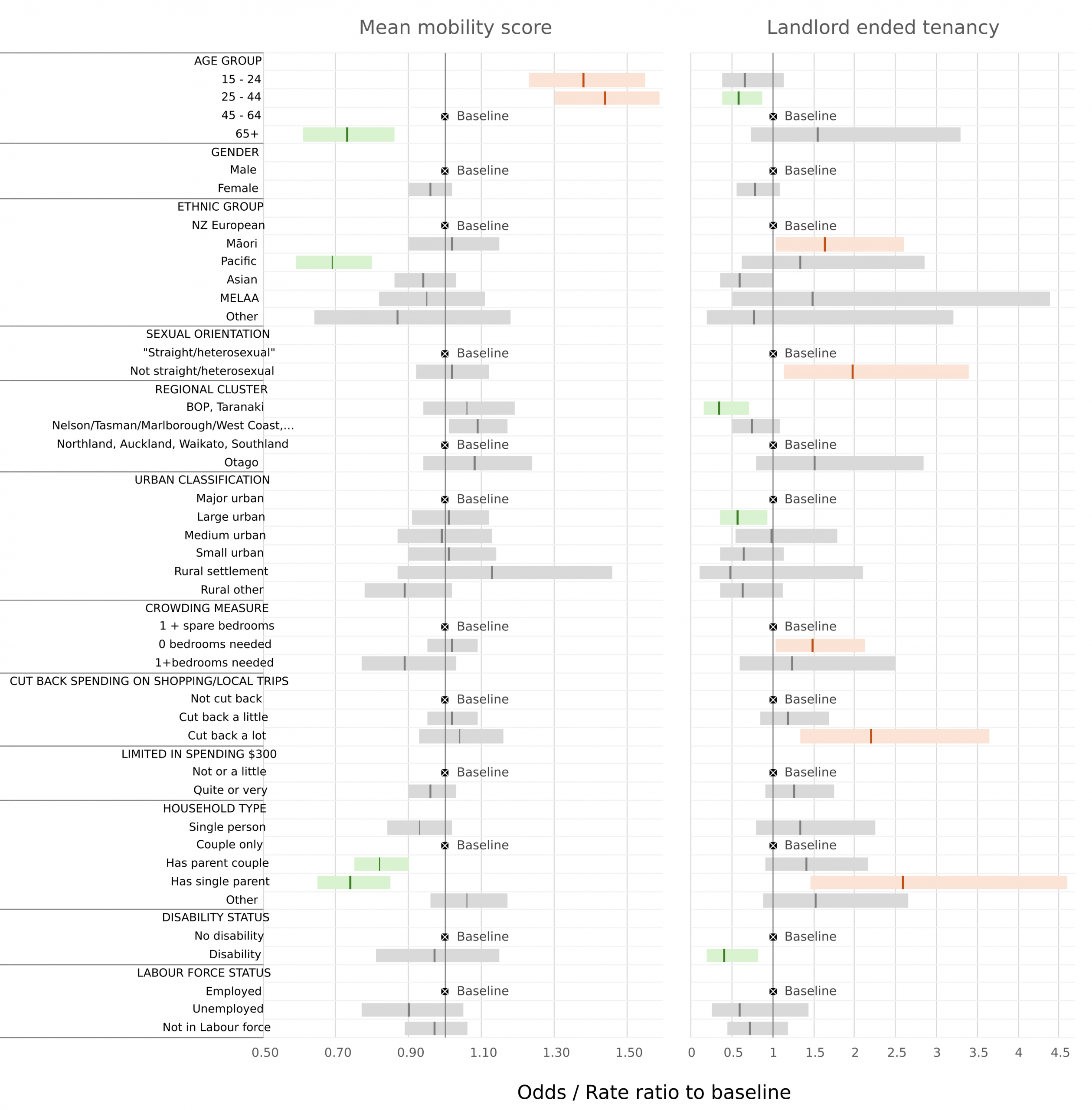
We modelled single and full multivariate differences between reference and comparison groups for previous renters’ landlord-ended tenancy likelihood and for current renters’ Mobility Scores (Figure 6 and Table 3). For landlord-ended tenancy likelihood we calculated odds ratios using logistic regression. For Mobility Scores, as raw data were moderately over dispersed we tested both negative binomial regression and Poisson regression with the survey-weighted data. Results were identical.
In each full multivariate model, we elected to use the questions ‘have you cut down on spending on shopping or local trips’ and ‘how limited would you feel in buying a non-essential item costing $300’ as better markers of individual financial stress than NZDep2018 quintile. The full models included all variables listed, meaning that results control for other listed variables, and that identified areas of advantage or disadvantage are cumulative.
Tenancy precariousness
After statistical analysis, demographic groups with either high or low likelihood of landlord-ended tenancy or mobility were categorised into ‘tenancy precariousness’ classifications, as follows. ‘High’/’Low’ meant the Mobility Score or likelihood of landlord-ended tenancy was above/below the 95 per cent confidence interval of the mean Score/likelihood and was shaded in pink/green in Table 3Table. At least one of the variables was required to be significantly different from the group baseline comparator (or, if baseline, from at least one other category) for the group to qualify for classification.
- ‘Precarious tenure’: high Mobility Score, high incidence of landlord-ended tenancies.
- ‘Reluctant movers’: low Mobility Score, high incidence of landlord-ended tenancies.
- ‘Self-mobile’: high Mobility Score, low incidence of landlord-ended tenancies, (that is, moving regularly, but by their own choice).
- ‘Tenure secure’: low Mobility Score, low incidence of landlord-ended tenancies.
Figure 3: Weighted percentages of respondents in rental tenure
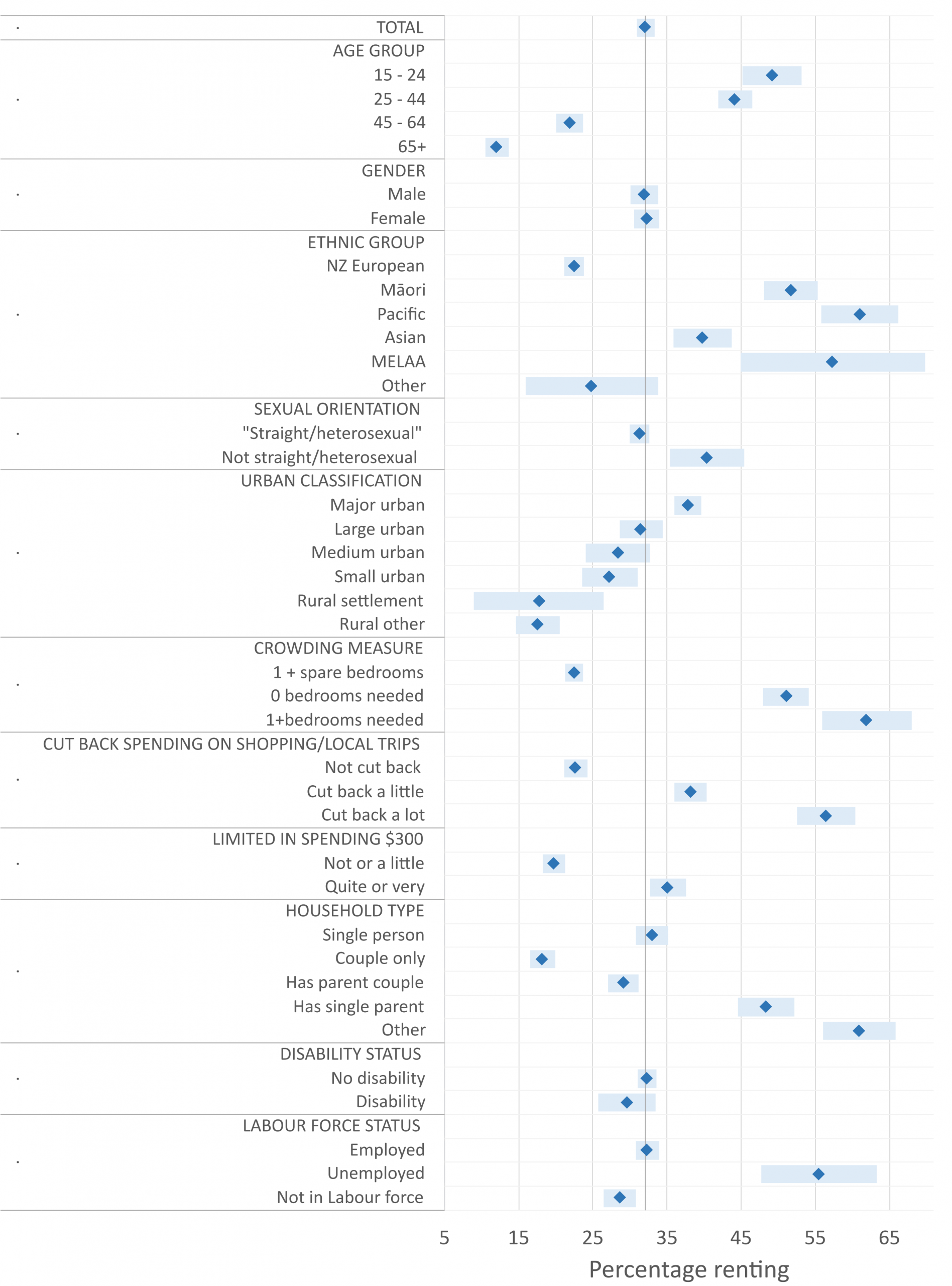
Figure 4: Weighted percentages of ‘previously renting’ respondents with landlord ended tenancies
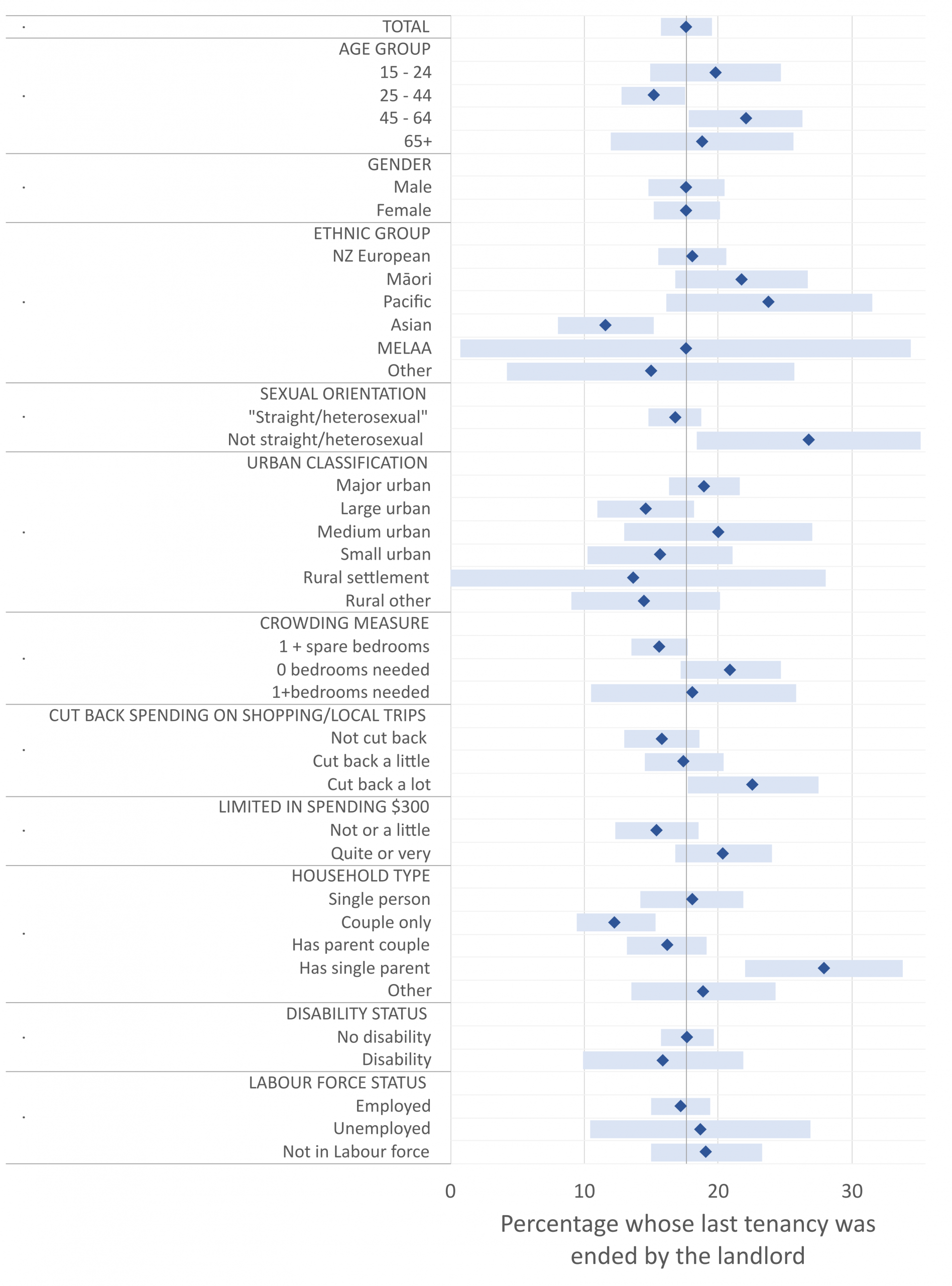
Figure 5: Weighted percentages of previously renting respondent mean Mobility Scores
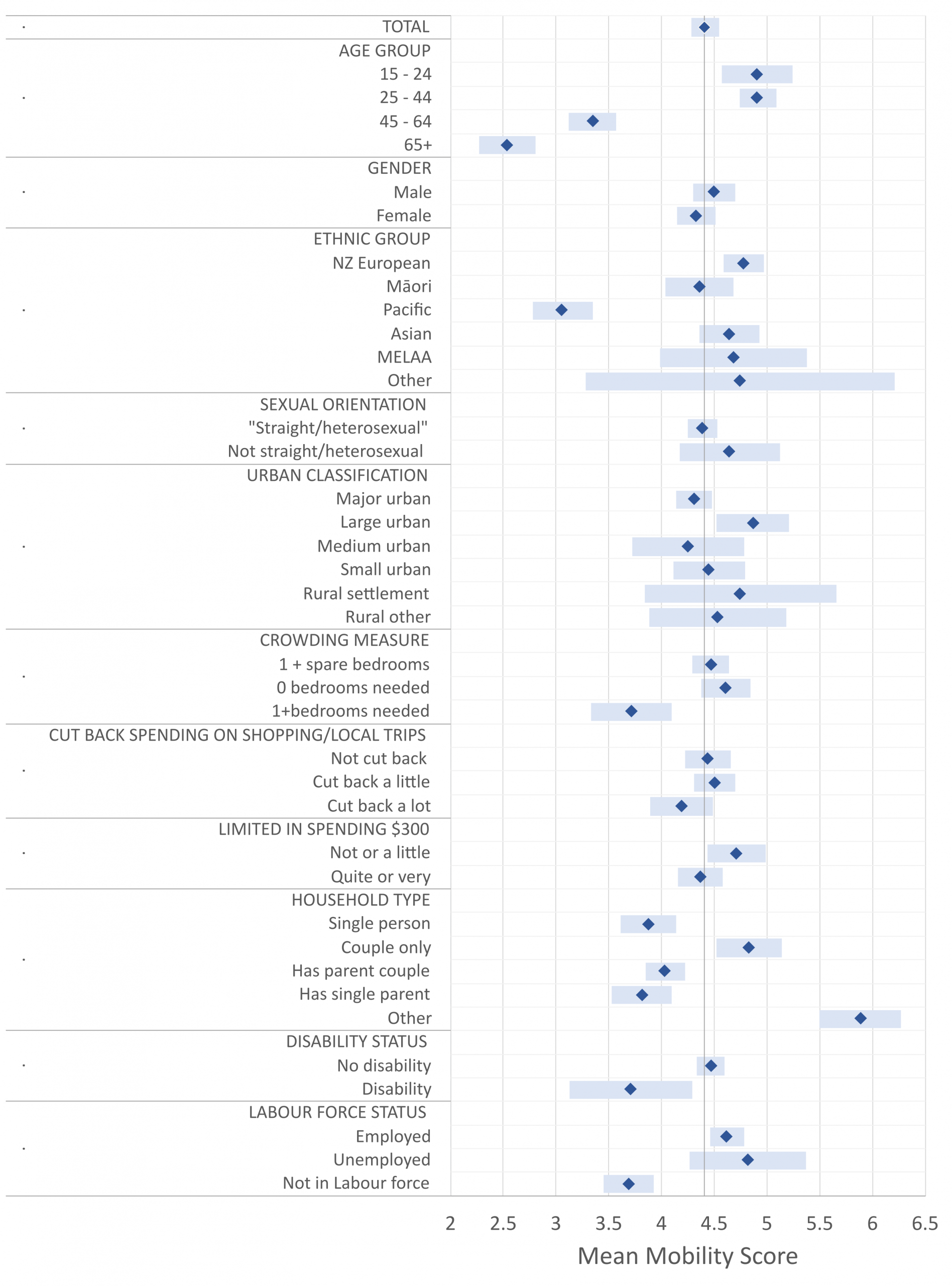
Figure 6: Weighted mean mobility scores (currently renting) and landlord-ended tenancies (previously renting) relative to baseline, full model
Strengths and limitations
Statistics NZ conducted the survey and calculated sample weights so as to make results nationally representative. However, the study does have limitations. It is possible some respondents selected ‘housing costs too expensive/moved to a cheaper house or flat’ rather than ‘tenancy was ended by landlord’ if their tenancy had been terminated for non-payment of rent, but only 5.9 per cent of respondents selected the ‘housing costs too expensive’ answer and adding them into the models made no meaningful difference to the results.
Details of the individual or household were collected at the time of the Survey, which was administered after any move. This is an important limitation to the household demographic data used in our analysis. While few people will have changed their sex, sexual orientation, or ethnicity, other characteristics have the potential to have changed when the respondent moved. In most instances, the potential bias arising from this data gap is towards the null. Risk by age will have been skewed slightly upwards, however the age groups are wide and average length of tenancy short, so the skew will be small.
In reporting demographic characteristics as risk factors for landlord-ended tenancy, we recognise that except for single-person households, the risk attaches not (only) to the individual, but also to the person’s household. However, it also means that characteristics of other household members associated with higher forced moves were unable to be measured, potentially underestimating any effect.
The inclusion criteria for the study will also have excluded people living in ‘emergency’ or ‘transitional housing’ (Human Rights Commission, 2022) from the analysis, estimated at 2,879 and 2,341 people respectively in June 2018 (Ministry of Social Development, 2018). Although some of these people may have been in employment, and total numbers represent only a small proportion of total unemployed, it is possible that findings for people who were unemployed could have been skewed by those in worst housing deprivation being excluded from the analysis. The 2018 data show a lower likelihood of landlord-ended tenancy than Witten et al.’s 2015 tenant survey (Witten et al., 2017). It is not possible to tell whether the difference is due to changes in property investor sales activity, to different sampling methodologies, or to some other difference between the data sources.
It is also important to note that while the Survey sampling resulted in a roughly representative proportion of public and community housing sector tenants (16 per cent of currently renting respondents), at the time of the survey NZ’s central government public housing provider was phasing in a ‘Sustaining Tenancies’ programme, aiming to work with tenants to avoid eviction except in rare circumstances (Mailing, 2022). The subsequent government ended the ‘Sustaining Tenancies’ policy in 2024, adding further tenure insecurity to present-day renters.
Other factors identified as risks in other studies, such as job loss, mental illness, hoarding disorder, experience of violence, neighbourhood crime, or substance abuse problems, were not able to be measured in this study.
Results
Full results are shown in Table 3.
Descriptive analysis
Rental tenure
Just under a third (32.1 per cent) of Survey respondents were ‘currently renting’. Likelihood of living in rental tenure varied extensively across different demographic categories. Rental tenure decreased with age, with 49.2 per cent of 15 to 24-year-olds living in rental accommodation, compared to 12.0 per cent of people aged 65+ years. Rental tenure also increased with increasing socio-economic deprivation (NZDep quintile). Others with high levels of rental tenure (significantly higher than average) were Māori, Pacific, Asian, and MELAA peoples; people who were not heterosexual; people who were unemployed; ‘other’ households (which include house shares) and single-parent households; households with no or 1+ bedrooms needed; people who had cut back a little or a lot on shopping or local trips; and people in major urban areas. People with lower levels of rental tenure (significantly less likely than average) were NZ Europeans; not in the labour force; in a couple only household or a household with a parent couple; and people in a household with a spare bedroom. Levels of rental tenure also increased with increasing settlement/urban size. Both males and females were equally likely to live in rental tenure (other gender identities were not collected in the data, and the data did not capture whether people were transgender).
Landlord-ended tenancy
Of respondents who were previously renting, 17.6 per cent said that the main reason for their most recent move was that their tenancy had been ended by the landlord. This reason was the second most common reason for moving, after ‘moved from rental to owned dwelling’ (20.6 per cent), and ahead of ‘social reasons’ (12.8 per cent), such as relationship change, or wanting to live closer to friends or family. For continuing tenant respondents, 25.4 per cent reported their last tenancy was ended by the landlord (Figure 2).
There were fewer differences in likelihood of landlord-ended tenancy than there were for likelihood of renting. Households with single parents had a higher than average percentage of landlord-ended tenancies. Asian peoples, people in couple-only households, and people in rural areas were less likely than average to have had their last tenancy ended by the landlord.
Mobility
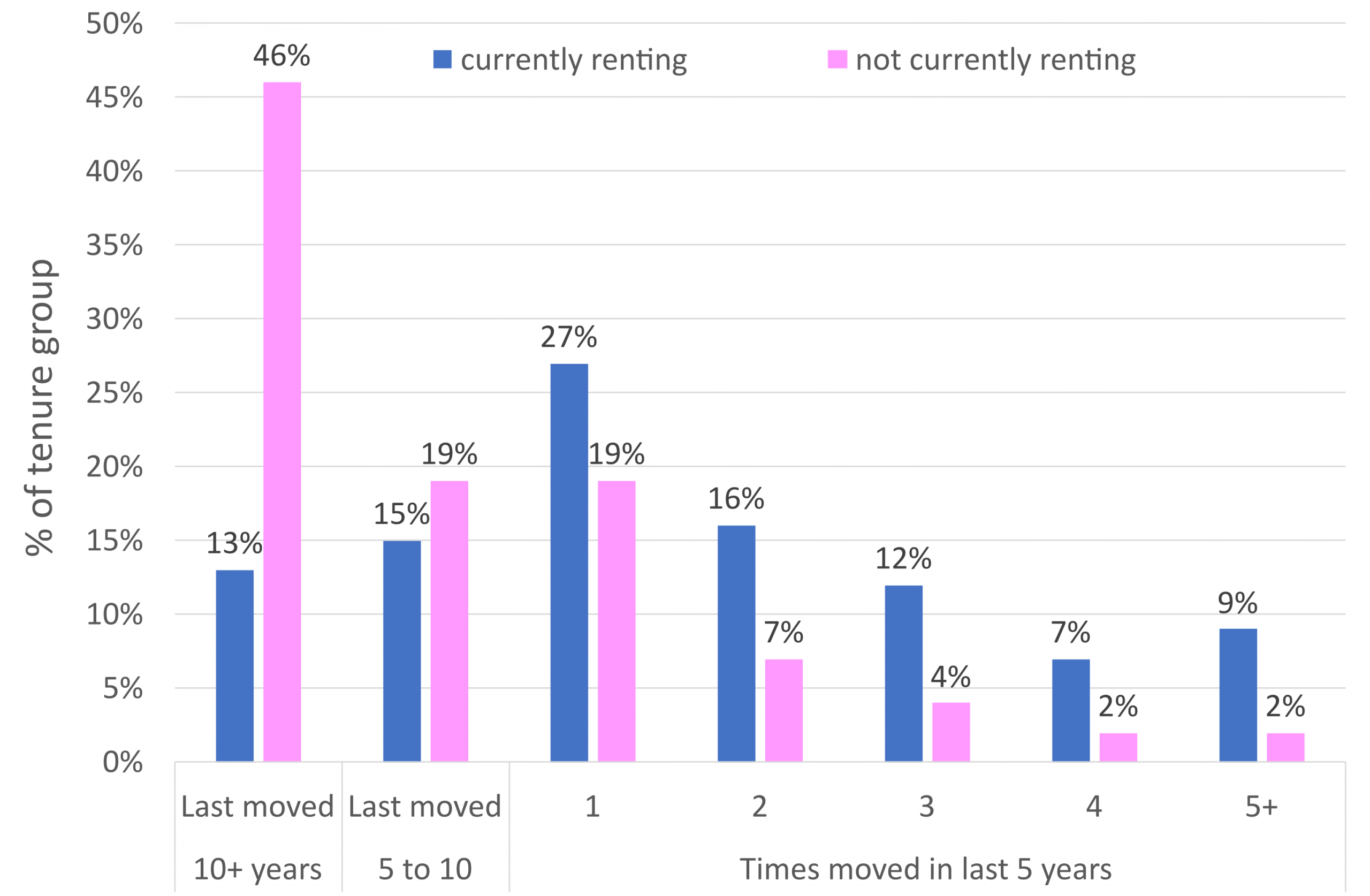
Nearly three-quarters (72.0 per cent) of currently renting respondents had lived at their current address less than five years, and a further 15.2 per cent between five and ten years; meaning 87.2 per cent had lived at their current address less than ten years (Figure 7). The Mobility Score for all respondents (i.e. all tenures) was 2.84, but for those currently renting it was 4.41. Mobility decreased as age increased. People with (significantly) higher than average mobility were NZ Europeans, people in ‘Other’ households, people in NZDep 1-2 and NZDep 5-6 areas. Groups whose mobility was significantly lower than average were Pacific Peoples; people not in the labour force; single-person households; people in households with children (parent couples or single parents); people in households needing a spare bedroom; and people in NZDep 9-10.
Table 3: Weighted percentages of respondents renting and with landlord ended tenancies, mean Mobility Scores, and rate and odds ratios, by demographic group
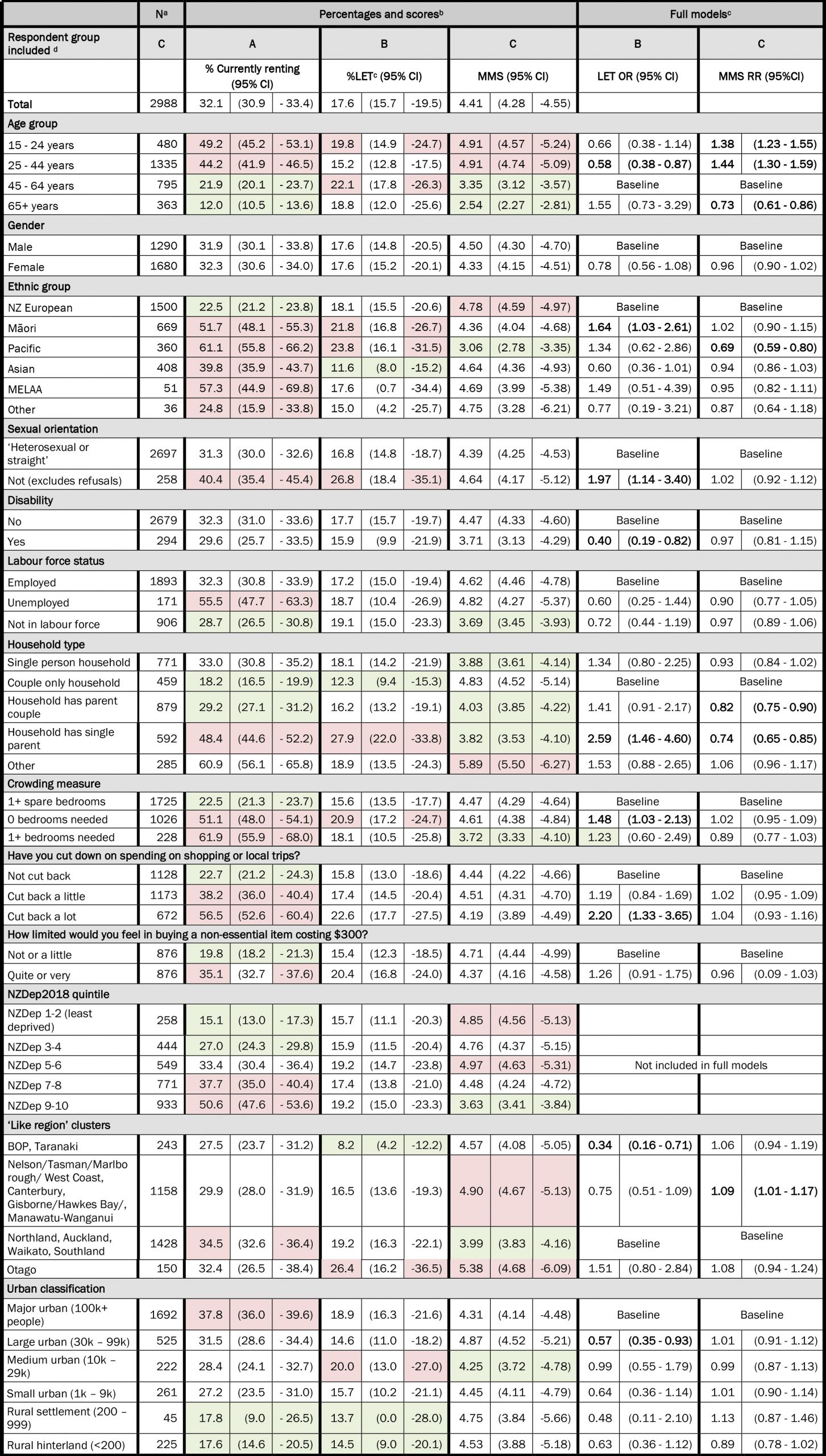
Shaded in pink= value higher than mean upper 95% confidence interval; shaded in green=value lower than mean lower 95% confidence interval.
a Unweighted count of respondents, random-rounded to base 3.
b RR and OR in bold have p-values <0.05.
c LET=Landlord-ended tenancy.
dA = All respondents; B = Previously renting; C = Currently renting.
Figure 7: Survey respondent mobility by tenure
Regression results
Mobility
After controlling for other variables, differences in mobility were significant across age-groups, but not linearly – mobility was significantly higher for age-groups younger than 45 years, and significantly higher for people aged 65+ years. Pacific Peoples’ mobility was significantly lower than NZ Europeans, but there was no difference for other ethnic groups. Households with children had significantly lower mobility than households without, whether the parents were single or in a couple. People living in the upper South Island, Bay of Plenty, and Manawatu-Wanganui (combined due to similar renting/mobility characteristics) had significantly higher mobility than in Northland, Auckland, Waikato and Southland (also combined).
Landlord-ended tenancy
After controlling for other variables, likelihood of landlord-ended tenancy was significantly higher for: Māori, compared to NZ European; people who were not heterosexual, compared to those who were; people in households with a single parent, compared to couple-only households; and people who had cut back a lot on spending on shopping or local trips compared to those who had not. Likelihood of landlord-ended tenancy was significantly lower for: people aged 25-44 years compared to those aged 45–64 years; people with disabilities, compared to those without; and people in large urban areas compared to those in major urban areas. Other differences were not statistically significant.
Tenure precariousness groups
People who were not heterosexual, people aged 15 to 24 years, and households with no additional bedrooms needed or spare, met the criteria for precarious tenure (high mobility, high incidence of landlord-ended tenancies). All these groups had high levels of renting.
Reluctant movers (low mobility, high incidence of landlord-ended tenancies) were 45 to 64-year olds, Pacific peoples, people who had cut back a lot on shopping or local trips, and single parent households. Among these groups, 45 to 64-year-olds had lower levels of renting. Other reluctant movers were more likely than average to be in rental tenure.
People in the 25 to 44 years age group; people in ‘large urban’ areas; and couple-only households; were self-mobile (high mobility, low incidence of landlord-ended tenancies). Likelihood of rental tenure in this category was heterogenous.
Significantly, no groups met tenure secure (low mobility, low incidence of landlord-ended tenancies) criteria.
Discussion
People at risk of having their tenancy ended by their landlord are a subset of those with low tenure security, since tenure insecurity includes both the frequency and nature of mobility. In our discussion we therefore begin with a broader summary of tenure security.
In assessing risk of landlord-ended tenancy, we must consider overall mobility. For example, amongst people aged 65+ years, of those previously renting 18.8 per cent said their most recent move was landlord-instigated. This means that for people aged 65+ years who are renting, a previous tenancy is roughly as likely as for other age groups to have been ended by the landlord, even though the older age group were much more likely to have lived at their current address for ten years or more (60.7 per cent). Thus, although the most recent move for people aged 65+ years was as likely as in other age groups to have been ended by the landlord, their total mobility was lower, so they have a lower overall risk of having to move homes because a landlord has given them notice.
Demographic groups who were particularly likely to be renting were respondents who were younger than 45 years; Māori, Pacific, Asian and MELAA ethnic groups; people in areas of higher socioeconomic deprivation; people who were not heterosexual; people with no spare bedroom; people who had recently cut back on shopping and local trips; single parent and ‘other’ (e.g., house-sharing/flatting) households; and people who were unemployed. Taken together, the likelihood of renting increases along the same lines as other markers of social, health and economic vulnerabilities, as well as by life stage. People with a higher likelihood of landlord-ended tenancy were a subset of these groups: Māori, ‘non-heterosexuals’, single parents, people with no spare bedrooms, and people who had recently cut back a lot on shopping and local trips. However, as the cut back on shopping was ‘recent’ when the survey was administered, it would have occurred after the change of tenancy rather than predicting it.
Higher levels of mobility, however, were less clearly associated with vulnerability: the wealthiest NZDep quintile (1-2) had one of the highest Mobility Scores, and the least wealthy NZDep quintile (9-10) one of the lowest. Low mobility – among the elderly, households with children, and Pacific peoples – might perhaps reflect desire for stability, despite the lack of control tenants had over tenancy continuity. Where potentially vulnerable rental households had low Mobility Scores, they also often had higher likelihood of landlord-ended tenancy. These higher landlord-ended tenancy levels did not necessarily mean landlords were moving them on more frequently: tenants who chose to stay longer in tenancies, and so only moved when landlords required them to moved, would have a high rate of landlord-ended tenancy. Affluent mobility, in contrast, might reflect the availability of other resources to compensate for the less desirable aspects of moving.
Our tenure precariousness classification brings together landlord-ended tenancy and frequency of moves; and should be interpreted in the context of likelihood of rental tenure. Groups who were both more likely than average to be in rental tenure, and at greater risk of precarious tenure, or perception of precarious tenure (potentially high among reluctant movers), were people aged 15-24 years, people who were not heterosexual, Pacific peoples, people who had cut back a lot on shopping or local trips, households with no bedrooms needed or spare, and single parent households. For these groups, tenure insecurity is yet another cumulative disadvantage among the many other stressors they face. For other groups vulnerable to disadvantage, it is perhaps more likely that there is wider heterogeneity in, rather than broad enjoyment of, tenure security. For groups among whom likelihood of renting may be lower—such as people aged 45-64 years – landlord-ended tenancy still adds to greater housing and health vulnerabilities (Pledger et al., 2019).
Consistency with previous findings
In contrast to overseas studies, neither gender (Beer et al., 2006; Desmond, 2012; Montgomery et al., 2017) nor living alone (Beer et al., 2006) appeared to increase risk of eviction. However, the higher landlord-ended tenancy risk found in this study for younger age groups (Montgomery et al., 2017), and for single parents (Beer et al., 2006), was consistent with overseas studies. The categorisation of Pacific peoples as reluctant movers was also consistent with overseas findings of higher risk for disadvantaged ethnic groups (Brisson & Covert, 2015).
Other comparisons were less clear. People who were unemployed, who might be analogous to people receiving welfare benefits, were not at obviously higher landlord-ended tenancy risk than other groups. Similarly, households with children did not show a high landlord-ended tenancy risk overall, though they were more likely than childless couples to have their previous tenancy ended by their landlord. It is not clear whether these findings are indicative of a socially inclusive society, whether there is a protective effect from the state welfare system allowing tenants to arrange for the welfare agency to pay their rent directly to the landlord, or whether there is some effect on results from people who were unemployed being more likely to be in housing not included in the Survey . Future research is needed to explore this.
As far as we are aware, this is the first study to examine and find that people who are not heterosexual are at higher risk of landlord-ended tenancy or eviction, compared to their heterosexual counterparts. This finding is significant; eviction is a significant precursor to homelessness, and considerable research shows that sexual minorities experience disproportionately high rates of homelessness when compared to their heterosexual counterparts (Fraser et al., 2019). Much of the existing international research on homelessness amongst sexual minorities focuses on the individual-level factors that cause homelessness, meaning wider social and structural factors remain under-explored (McCarthy & Parr, 2022). While we only explore one specific wider factor, we complement existing research showing the high rates of discrimination and housing instability amongst sexual minorities (Cusack et al., 2022; Fraser et al., 2022; Krause et al., 2016; Schwegman, 2019). Our findings emphasise the need to continue to interrogate these broader factors, and to understand the myriad of ways housing markets fail these sexual minorities.
Implications of tenure insecurity
That no demographic group could be said to be living in secure tenure while renting is a deeply concerning finding. The health and psycho-social advantages associated with residential stability are well-established, particularly for children (Jelleyman & Spencer, 2008; Nikolof et al., 2023; Simsek et al., 2021), but also for the elderly (James et al., 2020; James & Saville-Smith, 2018).True tenure security also supports ontological security – the mental stability and wellbeing that comes from having a sense of continuity and order in one’s life experiences (de Schrijver et al., 2022; Giddens, 1986; Padgett, 2007). Housing consistency (that is, security of tenure) has been proposed as one of the four housing pillars which promote health equity (Swope & Hernández, 2019). The lack of tenure security identified in this study is clear evidence of the failures of NZ’s PRS and the way it is (or is not) structured. Decades of political decisions which have entrenched minimal regulation of the system, given an unequal amount of power to landlords, and made it difficult for renters to seek redress have all contributed to this deep lack of tenure security (Bierre et al., 2010; Chisholm et al., 2020; James et al., 2020; Murphy, 2020; Toy-Cronin & Bierre, 2022; White & Nandedkar, 2021). Given the consistent and ongoing fall in homeownership rates in NZ (Stats NZ, 2020), this lack of tenure security amongst private renters is likely to remain a significant, and ongoing, problem. We anticipate this would be similar in other predominantly homeowner societies with minimally regulated private rental markets, but future research is needed.
Greater landlord power also increases risk of discriminatory outcomes. Landlords with conscious or unconscious biases about particular groups have a number of opportunities to act out that bias at different points in the tenant relationship. They may reject a tenant’s application to rent a property, leaving the applicant only with an unpleasant, but unprovable, suspicion that their rejection is based on their demographic characteristic (Fraser et al., 2021; Reosti, 2020; Rolfe et al., 2023). Alternatively – particularly if the ground of bias is potentially invisible, as with religion, political views, or sexual orientation – they may let to the tenant, but then act out their bias during the tenancy, whether by carrying out more frequent inspections, or applying more stringent expectations with regard to tidiness or timeliness with rent payments (Lister, 2002). Additional inspections and more stringent expectations create more opportunities for landlord dissatisfaction, and thus – particularly when no reason is required – have the potential to flow through into landlords ending tenancies or choosing not to renew a fixed term.
The groups identified in this study as being at higher risk of precarious tenure – young adults, ‘non-heterosexuals’, Pacific peoples, single parents, and people with a marker of tight finances (cutting back on shopping, or no spare bedroom) – include some, but not all, groups previously identified as experiencing housing discrimination.
For groups at risk of precarious tenure, their tenure insecurity compounds other forms of disadvantage more likely to be experienced by these groups, such as discrimination in other areas of life, socioeconomic disadvantage (Watt, 2020), or difficulties securing housing suitable for larger households. Tenure insecurity and forced moves for these groups may intersect with discrimination and greater difficulty in rehousing, compounding disadvantage.
While our findings reflect differences in the outcome of landlord-ended tenancies across groups, the research and dataset were not designed to identify the drivers and processes that led to those outcomes. From Witten et al 2017’s finding that 30 per cent of tenancy terminations were due to sale of property, we can see that housing financialisation has at least some impact, but allowing landlords to end a tenancy for property sale is ultimately a policy/legislative decision.
The finding that landlord-ended tenancy is a risk for all people renting means such tenancy terminations are not driven by tenant poverty alone, nor by poor quality housing. It is possible that tenants with greater socio-economic resources or cultural capital may, in some cases, be more able to negotiate with landlords or manage landlord perceptions in ways that reduce their risk of tenancy termination. However, such agency is likely limited by broader power asymmetries in landlord-tenant relationships. As Power & Gillon (2022) describe, tenants may attempt to ‘perform’ the role of the good tenant to secure housing stability, but this requires ongoing emotional and behavioural labour, and success is not guaranteed: we hypothesise that once a landlord has made a decision to end a tenancy, tenant influence is likely to be minimal.
Legislation and policy
On 11 February 2021, following a late 2019 change in government, substantial changes to NZ’s Residential Tenancies Act 1986 came into effect, intended to improve security of tenure. Before the change, landlords could legally end a tenancy for a range of reasons; or for no reason at all either at the end of a fixed-term tenancy or after issuing 90 days ‘no cause’ notice. After the change, the options for landlords to end a tenancy at the end of a fixed term or for ‘no cause’ were removed, and notice periods for remaining reasons to end a tenancy were lengthened (Residential Tenancies Amendment Act, 2020). We expect that these legislative changes likely improved tenure security somewhat, while the changes remained in place. However, after another change in government in 2023, the Residential Tenancies Amendment Act 2024 reinstated ‘no cause’ and end-of-fixed-term-tenancy notice options. The findings of this paper show this legislative reversion conflicts with tenants’ need for as much tenure security as the law can provide. We have seen no evidence beyond second-hand anecdote for politicians’ assertions that landlords were leaving properties empty rather than ‘take a chance’ on tenants with ‘poor rental histories’ (Neilson, 2023). Landlord lobby groups assert that ‘there’s always a reason for ending a tenancy agreement’ (Key reform will only protect bad tenants, 2019), but tenants’ many successful Tenancy Tribunal cases against retaliatory eviction, and other studies such as Chisholm et al (2017) demonstrate that not all those ‘reasons’ are in fact reasonable. Further, expecting tenants to enforce retaliatory eviction in the Tenancy Tribunal, or relying on landlords’ reasonableness, is analogous to relying on landlord compassion over rent arrears (Bierre & Howden-Chapman, 2024), and creates the same issues of power, identified in multiple studies in multiple landlord-tenant relationship contexts (Byrne & McArdle, 2022; Chisholm et al., 2020; Soaita & McKee, 2019). However, even without no-cause notice, many of the fundamental structural and political issues remain.
We observe that NZ’s reinstatement of no-cause notice provisions is out of step with the direction of legislative changes in other jurisdictions. In the UK, Scotland abolished no-cause notice in 2017 (Private Housing (Tenancies) (Scotland) Act, 2016), while in England and Wales, the Renters’ Rights Bill 2025, which removes no-cause notice, is expected to receive Royal Assent in late 2025 or early 2026. In Australia, both Victoria and New South Wales have recently banned no-fault evictions (Consumer and Planning Legislation Amendment (Housing Statement Reform) Act, 2025; Residential Tenancies Amendment Act [NSW], 2024). In the USA, no-cause notice laws vary by city and state, but a range of jurisdictions prohibit no-cause notice (Card et al., 2025).
While this study’s findings are specific to NZ, we would expect tenant experiences to be similar in other jurisdictions where no-cause notice is (still) allowed, and where rental markets are also dominated by private landlords. As other jurisdictions move to limit or abolish no-cause notice, these findings reinforce the importance of secure rental tenure as a foundation for health and social equity, and show that the burden of legislative inaction or political opposition impacts not just population groups that are already marginalised, but tenants in general.
Further research needed
Future research could explore whether tenant outcomes differ depending on the reason for tenancy termination (e.g. sale vs rent arrears), and whether tenants’ perceptions of insecurity correlate with their actual risk. Larger studies with sufficient power for intersectional analyses would help clarify how risks are compounded across multiple lines of marginalisation, discrimination, and oppression. Finally, investigation of any changes in tenure security between 2021 and 2025 could highlight differences between economic and legal reasons for housing insecurity.
Conclusion
While some groups were less secure than others, no NZ private rental tenant in any demographic group could be said to live in secure tenure: no group had both markedly lower than average mobility, and lower than average likelihood of having their previous tenancy ended by the landlord rather than personal choice. Landlord-ended tenancy was a particular risk for tenants who were young, not heterosexual, or with no bedroom spare. All these groups were more likely to rent their homes. Tenants who were of Pacific ethnicity, single parent households, 45–64-year-olds, and people who had needed to cut back on shopping or local trips, were also potentially less likely to feel secure in their tenure, since they were unlikely to initiate moving themselves but still experienced high levels of landlord-ended tenancies. Conversely, people in the 25-44-year age group, people in ‘large urban’ areas, and couple-only households, were choosing to move more often and were less likely to be moved on by the landlord. Many of the groups found to be experiencing increased risk of landlord-ended tenancy were generally consistent with groups other studies have identified as experiencing discrimination in other areas of life, however this study is the first to identify an increased risk of landlord-ended tenancy, or eviction, as associated with ‘non-heterosexual’ sexual orientations.
These findings show a systemic failure within NZ’s private rental market to enable tenants to achieve stability or security of tenure. The broad risk of landlord-ended tenancy demonstrates that legislation to ensure tenants’ stability and security of tenure needs to be further strengthened rather than undone.
This work was supported by the Marsden Fund Council from New Zealand Government funding, managed by Royal Society Te Apārangi. Research Project Id: 17-UOO-207.
The data that support the findings of this study are available within NZ’s Integrated Data Infrastructure. Restrictions apply to the availability of these data, which were used under license for this study.
These results are not official statistics. They have been created for research purposes from the Integrated Data Infrastructure, which is carefully managed by StatsNZ. For more information about the IDI, please visit https://www.stats.govt.nz/integrated-data/ Access to the data used in this study was provided by Stats NZ under conditions designed to give effect to the security and confidentiality provisions of the Data and Statistics Act 2022. The results presented in this study are the work of the author, not Stats NZ or individual data suppliers.
Lucy Telfar-Barnard, He Kainga Oranga Housing and Health Research Programme, Department of Public Health, University of Otago, PO Box 7343, Wellington South, New Zealand 6242. Email: lucy.telfar-barnard@otago.ac.nz
Aalberts, R. J. (1998). Suits to void discrimination evictions of disabled tenants under the fair housing amendments act: an emerging conflict. Real Property, Probate and Trust Journal, 33(4), 649-684. https://heinonline.org/HOL/Page?collection=journals&handle=hein.journals/rpptj33&id=663&men_tab=srchresults
Atkinson, J., Salmond, C., & Crampton, P. (2020). NZDep2018 Index of Deprivation, Final Research Report, December 2020. University of Otago. https://www.otago.ac.nz/wellington/otago823833.pdf
Bastos, J. L., Celeste, R. K., Silva, D. A., Priest, N., & Paradies, Y. C. (2015). Assessing mediators between discrimination, health behaviours and physical health outcomes: a representative cross-sectional study. Social Psychiatry and Psychiatric Epidemiology, 50(11), 1731-1742. CrossRef link
Beer, A., Slatter, M., Baulderstone, J., & Habibis, D. (2006). Evictions and housing management. Australian Housing and Urban Research Institute Limited. https://www.ahuri.edu.au/research/final-reports/94
Bell, M. (2021). Nearly 80 per cent of landlords own just one property, data shows. stuff.co.nz. https://www.stuff.co.nz/life-style/homed/real-estate/124320645/nearly-80-per-cent-of-landlords-own-just-one-property-data-shows
Bierre, S., & Howden-Chapman, P. (2024). The theory and practice of a politics of compassion in the private rental sector: a study of Aotearoa, NZ and ‘kindness’ during the COVID-19 pandemic. International Journal of Housing Policy, 24(2), 268-289. CrossRef link
Bierre, S., Howden-Chapman, P., & Signal, L. (2010). ‘Ma and Pa’ Landlords and the ‘Risky’ Tenant: Discourses in the New Zealand Private Rental Sector. Housing studies, 25(1), 21-38. CrossRef link
Bower, M., Buckle, C., Rugel, E., Donohoe-Bales, A., McGrath, L., Gournay, K., Barrett, E., Phibbs, P., & Teesson, M. (2021). ‘Trapped’, ‘anxious’ and ‘traumatised’: COVID-19 intensified the impact of housing inequality on Australians’ mental health. International Journal of Housing Policy, 1-32. CrossRef link
Brisson, D., & Covert, J. (2015). Housing instability risk among subsidized housing recipients: Characteristics associated with late or nonpayment of rent. Social Work, 39, 119-128. CrossRef link
Bullinger, L. R., & Fong, K. (2021). Evictions and neighborhood child maltreatment reports. Housing Policy Debate, 31(3-5), 490-515. CrossRef link
Byrne, M., & McArdle, R. (2022). Secure occupancy, power and the landlord-tenant relation: a qualitative exploration of the Irish private rental sector. Housing studies, 37(1), 124-142. CrossRef link
Card, K., Davis, E., & Goetz, E. (2025). Do Good Cause eviction protections reduce the rate of housing production? U. o. M. Center for Urban and Regional Affairs. https://www.cura.umn.edu/sites/cura.umn.edu/files/2025-03/final_the-good-case-for-_good-cause-v2.pdf
Carr, H., & Kirton-Darling, E. (2024). ‘No-fault evictions’ to be banned in England – but it won’t solve private renters’ problems. Retrieved 30 September 2024, from https://theconversation.com/no-fault-evictions-to-be-banned-in-england-but-it-wont-solve-private-renters-problems-237422
Carrere, J., Vásquez-Vera, H., Pérez-Luna, A., Novoa, A. M., & Borrell, C. (2022). Housing insecurity and mental health: the effect of housing tenure and the coexistence of life insecurities. Journal of Urban Health, 99(2), 268-276. CrossRef link
Chisholm, E., Bierre, S., Davies, C., & Howden-Chapman, P. (2022). ‘That house was a home’: Qualitative evidence from New Zealand on the connections between rental housing eviction and poor health outcomes. Health Promotion Journal of Australia, 33(3), 861-868. CrossRef link
Chisholm, E., Howden-Chapman, P., & Fougere, G. (2017). Renting in New Zealand: perspectives from tenant advocates. Kōtuitui: New Zealand Journal of Social Sciences Online, 12(1), 95-110. CrossRef link
Chisholm, E., Howden-Chapman, P., & Fougere, G. (2020). Tenants’ Responses to Substandard Housing: Hidden and Invisible Power and the Failure of Rental Housing Regulation. Housing, Theory and Society, 37(2), 139-161. CrossRef link
Collins, A. B., Boyd, J., Damon, W., Czechaczek, S., Krüsi, A., Cooper, H., & McNeil, R. (2018). Surviving the housing crisis: Social violence and the production of evictions among women who use drugs in Vancouver, Canada. Health Place, 51, 174-181. CrossRef link
Consumer and Planning Legislation Amendment (Housing Statement Reform) Act, (2025). https://www.legislation.vic.gov.au/as-made/acts/consumer-and-planning-legislation-amendment-housing-statement-reform-act-2025
Cross, R. I., Huỳnh, J., Bradford, N. J., & Francis, B. (2023). Racialized Housing Discrimination and Population Health: a Scoping Review and Research Agenda. Journal of Urban Health, 100(2), 355-388. CrossRef link
Cusack, M., Montgomery, A. E., & Byrne, T. (2022). Examining the Intersection of Housing Instability and Violence among LGBTQ Adults. Journal of Homosexuality, 1-12. CrossRef link
de Schrijver, E., Bundo, M., Ragettli, M. S., Sera, F., Gasparrini, A., Franco, O. H., & Vicedo-Cabrera, A. M. (2022). Nationwide Analysis of the Heat- and Cold-Related Mortality Trends in Switzerland between 1969 and 2017: The Role of Population Aging. Environmental Health Perspectives, 130(3), 37001. CrossRef link
Desmond, M. (2012). Eviction and the reproduction of urban poverty. American Journal of Sociology, 118, 88-133. CrossRef link
Desmond, M. (2016). Evicted: Poverty and profit in the American city. Crown Publishers.
Fraser, B., Chisholm, E., & Pierse, N. (2021). “You’re so powerless”: Takatāpui/LGBTIQ+ people’s experiences before becoming homeless in Aotearoa New Zealand. PloS One, 16(12), e0259799. CrossRef link
Fraser, B., Jiang, T., Cordue, H., & Pierse, N. (2022). Housing, Instability, and Discrimination amongst Takatāpui/LGBTIQ+ Youth in Aotearoa New Zealand. Youth, 2(3), 339-351. https://www.mdpi.com/2673-995X/2/3/25
Fraser, B., Pierse, N., Chisholm, E., & Cook, H. (2019). LGBTIQ+ homelessness: a review of the literature. International Journal of Environmental Research and Public Health, 16(15). CrossRef link
Friedman, S., & Nakatsuka, M. (2021). Racial and ethnic disparities in housing insecurity Addressing differential Impacts of COVD-19 in New York State: A symposium, Albany. https://scholarsarchive.library.albany.edu/covid_mhd_nys_2021symposium/day2/agenda/6/
Gibson, A. (2019, 18 Nov). Now and then: Landlord/tenant law overhaul, how 1.5m lives could change.
Giddens, A. (1986). The Constitution of Society: Outline of the Theory of Structuration. University of California Press.
Gillespie, S., Cardeli, E., Sideridis, G., Issa, O., & Ellis, B. H. (2020). Residential mobility, mental health, and community violence exposure among Somali refugees and immigrants in North America. Health Place, 65, 102419. CrossRef link
Grainger, G. L. (2021). “It’s Not a Pattern of Behavior”: Proxy Deflection of Eviction Stigma by Community Care Providers. Symbolic Interaction, 44(3), 479-503. CrossRef link
Hobbs, K. G. (2021). On the prevalence and prevention of rental housing evictions [PhD dissertation, University of North Carolina, Greensboro]. http://libres.uncg.edu/ir/uncg/f/Hobbs_uncg_0154D_13230.pdf
Hoke, M. K., & Boen, C. E. (2021). The health impacts of eviction: Evidence from the national longitudinal study of adolescent to adult health. Social Science and Medicine, 273, 113742. CrossRef link
Human Rights Commission. (2022). Homelessness and human rights: A review of the emergency housing system in Aotearoa New Zealand. https://assets.nationbuilder.com/nzhrc/pages/3403/attachments/original/1670900354/Report_-_Homelessness_and_human_rights_review.pdf
James, B., Bates, L., Coleman, T. M., Kearns, R., & Cram, F. (2020). Tenure insecurity, precarious housing and hidden homelessness among older renters in New Zealand. Housing studies, 37(3), 483-505. CrossRef link
James, B., & Saville-Smith, N. (2016). Tenure security for older tenants: a country review of policy, programmes and regulation. Smartgrowth; Population ageing Technical Advisory Group: Western Bay of Plenty Sub-region. https://smartgrowthbop.org.nz/media/1657/tenure-securityoverview-final-july.pdf
James, B., & Saville-Smith, N. (2018). Tenure insecurity and exclusion: older people in New Zealand’s rental market European Network of Housing Researchers Conference, Uppsala, Sweden. https://www.buildingbetter.nz/publications/homes_spaces/adm/James_Saville-Smith_2018_tenure_insecurity_exclusion.pdf
Jelleyman, T., & Spencer, N. (2008). Residential mobility in childhood and health outcomes: a systematic review. J Epidemiol Community Health, 62(7), 584-592. CrossRef link
Kang, S. (2021). Beyond households: regional determinants of housing instability among low-income renters in the United States. Housing studies, 36(1), 80-109. CrossRef link
Krause, K. D., Kapadia, F., Ompad, D. C., D’Avanzo, P. A., Duncan, D. T., & Halkitis, P. N. (2016). Early Life Psychosocial Stressors and Housing Instability among Young Sexual Minority Men: the P18 Cohort Study. Journal of Urban Health, 93(3), 511-525. CrossRef link
Landlords.co.nz. (2016, November 30). Fixed‑term tenancies most popular. https://www.landlords.co.nz/article/976513073/fixed-term-tenancies-most-popular
Landlords.co.nz. (2019, November 18). Key reform will only protect bad tenants. https://www.landlords.co.nz/article/976515927/key-reform-will-only-protect-bad-tenants
Lapidus, L. M. (2002). Doubly victimized: housing discrimination against victims of domestic violence. American University Journal of Gender, Social Policy & the Law, 11(2), 377-392.
Lister, D. (2002). Controlling Letting Arrangements? Landlords and surveillance in the private rented sector? Surveillance & Society, 2(4). CrossRef link
Lochhead, E. (2021). Identifying differences in the household and neighborhood factors associated with formal and informal evictions Tufts University]. Massachusetts, USA. https://www.proquest.com/docview/2544914837?pq-origsite=gscholar&fromopenview=true
Lu, P., Kong, D., Shelley, M., & Davitt, J. K. (2022). Intersectional Discrimination Attributions and Health Outcomes Among American Older Adults: A Latent Class Analysis. International Journal of Aging and Human Development, 95(3), 267-285. CrossRef link
Mailing, N. (2022). Official Information Act request response. Sustaining tenancies and disruptive behaviour policies. National Services, Kāinga Ora. https://kaingaora.govt.nz/assets/Publications/OIAs-Official-Information-Requests/January-2022/Sustaining-Tenancies-and-Disruptive-Behaviour-Policies.pdf
McCarthy, L., & Parr, S. (2022). Is LGBT homelessness different? Reviewing the relationship between LGBT identity and homelessness. Housing studies, 1-19. CrossRef link
Mensah, J., & Tucker-Simmons, D. (2021). Social (in)justice and rental housing discrimination in urban Canada: the case of ethno-racial minorities in the Herongate community in Ottawa. Studies in Social Justice, 15(1). CrossRef link
Merritt, B., & Farnworth, M. D. (2021). State landlord–tenant policy and eviction rates in majority-minority neighborhoods. Housing Policy Debate, 31(3-5), 562-581. CrossRef link
Ministry of Housing and Urban Development. (2022). Residential property management regulatory options: A discussion paper. https://www.hud.govt.nz/assets/Uploads/Documents/Residential-Property-Management-Regulatory-Options-discussion-paper-February-2022.pdf
Ministry of Social Development. (2018). Housing Quarterly Report: June.
Moger, L. (2023). What is a fixed-term tenancy? Pros and cons. Retrieved 27 April 2023 from https://www.opespartners.co.nz/property-management/fixed-term-tenancy
Montgomery, A. E., Cusack, M., Szymkowiak, D., Fargo, J., & O’Toole, T. (2017). Factors contributing to eviction from permanent supportive housing: Lessons from HUD-VASH. Evaluation and Program Planning, 61, 55-63. CrossRef link
Murphy, L. (2020). Neoliberal social housing policies, market logics and social rented housing reforms in New Zealand. International Journal of Housing Policy, 20(2), 229-251. CrossRef link
Nathan, K., Robertson, O., Atatoa Carr, P., Howden-Chapman, P., & Pierse, N. (2019). Residential mobility and socioemotional and behavioural difficulties in a preschool population cohort of New Zealand children. Journal of Epidemiology and Community Health, 73(10), 947-953. CrossRef link
Nathan, K., Robertson, O., Atatoa Carr, P., Howden-Chapman, P., & Pierse, N. (2022). Residential mobility and potentially avoidable hospitalisations in a population-based cohort of New Zealand children. Journal of Epidemiology and Community Health, 76(6), 606-612. CrossRef link
Neilson, M. (2023, 27 April). National will reinstate no-cause evictions, says regulations hurting landlords and driving up rental prices.
Nikolof, A., Brown, S. J., Clark, Y., Glover, K., & Gartland, D. (2023). A Systematic Review of Child Health, Developmental and Educational Outcomes Associated with High Mobility in Indigenous Children from Australia, Canada and New Zealand. Int J Environ Res Public Health, 20(5). CrossRef link
Ong ViforJ, R., Hewton, J., Bawa, S., & Singh, R. (2023). Forced housing mobility and mental wellbeing: evidence from Australia. International Journal of Housing Policy, 23(1), 138-162. CrossRef link
Padgett, D. K. (2007). There’s no place like (a) home: ontological security among persons with serious mental illness in the United States. Soc Sci Med, 64(9), 1925-1936. CrossRef link
Pleasence, P., & Balmer, N. (2008). Mental health and the experience of housing problems involving rights. People, Place and Policy, 2(1), 4-16. CrossRef link
Pledger, M., McDonald, J., Dunn, P., Cumming, J., & Saville-Smith, K. (2019). The health of older New Zealanders in relation to housing tenure: analysis of pooled data from three consecutive, annual New Zealand Health Surveys. Australian and New Zealand Journal of Public Health. CrossRef link
Power, E. R. (2022). Mobility-based disadvantage in older age: insecure housing and the risks of moving house. Ageing and Society, 42(1), 89-111. CrossRef link
Power, E. R., & Gillon, C. (2022). Performing the ‘good tenant’. Housing studies, 37(3), 459-482. CrossRef link
Private Housing (Tenancies) (Scotland) Act 2016 [Scotland], (2016). https://www.legislation.gov.uk/asp/2016/19/contents
Quinovic. (2020). Fixed-Term vs Periodic Tenancies: Which is better for you? Retrieved 27 April 2023 from
Reosti, A. (2020). “We Go Totally Subjective”: Discretion, Discrimination, and Tenant Screening in a Landlord’s Market. Law & Social Inquiry, 45(3), 618-657. CrossRef link
Residential Tenancies Act [New Zealand]. (1986). https://www.legislation.govt.nz/act/public/1986/0120/latest/DLM94278.html
Residential Tenancies Amendment Act [New Zealand].. (2020). https://www.legislation.govt.nz/act/public/2020/0059/latest/whole.html#LMS294938
Residential Tenancies Amendment Act [New Zealand]. (2024). https://legislation.nsw.gov.au/view/pdf/asmade/act-2024-75
Residential Tenancies Amendment Act [New Zealand]. (2024). https://www.legislation.govt.nz/act/public/2024/52/en/latest/#LMS960501
Riggs, L., Keall, M., Howden-Chapman, P., & Baker, M. G. (2021). Environmental burden of disease from unsafe and substandard housing, New Zealand, 2010-2017. Bulletin of the World Health Organization, 99(4), 259-270. CrossRef link
Rolfe, S., McKee, K., Feather, J., Simcock, T., & Hoolachan, J. (2023). The role of private landlords in making a rented house a home. International Journal of Housing Policy, 23(1), 113-137. CrossRef link
Ross, K. M. (2007). Eviction, discrimination, and domestic violence: unfair housing practices against domestic violence survivors. Hastings Women’s Law Journal, 18(2), 249-268. https://heinonline.org/HOL/Page?handle=hein.journals/haswo18&div=20&g_sent=1&casa_token=&collection=journals#
Schwegman, D. (2019). Rental Market Discrimination Against Same-Sex Couples: Evidence From a Pairwise-Matched Email Correspondence Test. Housing Policy Debate, 29(2), 250-272. CrossRef link
Serjeant, E., Coleman, T., & Kearns, R. (2022). How tenants in New Zealand respond to winter weather indoors: A qualitative investigation. Health & Place, 75, 102810. CrossRef link
Simsek, M., Costa, R., & de Valk, H. A. G. (2021). Childhood residential mobility and health outcomes: A meta-analysis. Health Place, 71, 102650. CrossRef link
Smith, P. D., Keene, D. E., Dilday, S., Blankenship, K. M., & Groves, A. K. (2024). Eviction from rental housing and its links to health: A scoping review. Health & Place, 86, 103182. CrossRef link
Soaita, A. M., & McKee, K. (2019). Assembling a ‘kind of’ home in the UK private renting sector. Geoforum, 103, 148-157. CrossRef link
Soda, R., Okada, C., Takahashi, K., Katagi, S., Kanehiro, A., Kimura, G., Okamoto, S., Tada, S., & Kimura, I. (1993). [Predicting the clinical efficacy of house dust mite immunotherapy in bronchial asthmatics by multiple quantification analysis type II]. Arerugi Japanese Journal of Allergology, 42(12), 1771-1775.
Stats NZ. (2012). Crowded housing in New Zealand 1986–2006. https://statsnz.contentdm.oclc.org/digital/api/collection/p20045coll1/id/2839/download
Stats NZ. (2018a). General Social Survey 2018: Final content. https://www.stats.govt.nz/assets/Uploads/Reports/General-Social-Survey-2018-final-content/general-social-survey-2018-final-content.pdf
Stats NZ. (2018b). GSS 2018 data collection [Data set]. https://datainfoplus.stats.govt.nz/item/nz.govt.stats/20358850-bcde-4d9c-aac6-6c89f7044a94/9
Stats NZ. (2018c). New Zealand General Social Survey 2018 [Data set]. https://cdm20045.contentdm.oclc.org/digital/collection/p20045coll2/id/800/rec/6
Stats NZ. (2018d). Wellbeing statistics: 2018 – housing quality and tenure security [Data set]. https://www.stats.govt.nz/assets/Uploads/Well-being-statistics/Well-being-statistics-2018/Download-data/wellbeing-statistics-2018-housing-quality-and-tenure-security.xlsx
Stats NZ. (2020). Housing in Aotearoa: 2020. https://www.stats.govt.nz/reports/housing-in-aotearoa-2020
Stats NZ. (2021a). Functional urban areas: Methodology and classification. https://www.stats.govt.nz/methods/functional-urban-areas-methodology-and-classification/
Stats NZ. (2021b). Integrated Data Infrastructure. https://www.stats.govt.nz/integrated-data/integrated-data-infrastructure/
Stenberg, S.-Å., Kåreholt, I., & Carroll, E. (1995). The precariously housed and the risk of homelessness: a longitudinal study of evictions in Sweden in the 1980s. Acta Sociologica, 38(2), 151-165. CrossRef link
Sutter, M., & Perrin, P. B. (2016). Discrimination, mental health, and suicidal ideation among LGBTQ people of color. Journal of Counseling Psychology, 63(1), 98-105. CrossRef link
Swope, C. B., & Hernández, D. (2019). Housing as a determinant of health equity: A conceptual model. Social Science and Medicine, 243, 112571. CrossRef link
Toy-Cronin, B., & Bierre, S. (2022). Sustaining Tenancies or Swift Evictions: Rent Arrears in the Tenancy Tribunal. Victoria University of Wellington Law Review, 53(1), 105-128. CrossRef link
Tsai, J., & Huang, M. (2019). Systematic review of psychosocial factors associated with evictions. Health and Social Care in the Community, 27(3), e1-e9. CrossRef link
Van Laere, I., De Wit, M., & Klazinga, N. (2009). Preventing evictions as a potential public health intervention: Characteristics and social medical risk factors of households at risk in Amsterdam. Scandinavian Journal of Public Health, 37(7), 697-705. CrossRef link
Vásquez-Vera, C., Carrere, J., Borrell, C., & Vásquez-Vera, H. (2022). Neglected housing insecurity and its relationship with renters health: the case of Barcelona, Spain. Gaceta Sanitaria, 36(3), 207-213. CrossRef link
Vásquez-Vera, H., León-Gómez, B. B., Palència, L., Pérez, K., & Borrell, C. (2021). Health effects of housing insecurity and unaffordability in the general population in Barcelona, Spain. Journal of Urban Health, 98(4), 496-504. CrossRef link
Waldegrave, C., & Urbanová, M. (2016). Social and economic impacts of housing tenure: A report for the New Zealand Housing Foundation. Family Centre Social Policy Research Unit. https://communityhousing.org.nz/Downloads/Social%20and%20Economic%20Impacts%20of%20Housing%20Tenure%20FCSPRU.pdf
Watt, P. (2020). ‘Press-ganged’ Generation Rent: youth homelessness, precarity and poverty in east London. People, Place and Policy, 14(2), 128-141. CrossRef link
White, I., & Nandedkar, G. (2021). The housing crisis as an ideological artefact: Analysing how political discourse defines, diagnoses, and responds. Housing studies, 36(2), 213-234. CrossRef link
Wilson, B. D. M., O’Neill, K., & Vasquez, L. A. (2021). LGBT Renters and Eviction Risk. The Williams Institute. https://escholarship.org/uc/item/9tq530wt
Witten, K., Wall, M., Carroll, P., Telfar-Barnard, L., Asiasiga, L., Graydon-Guy, T., Huckle, T., & Scott, K. (2017). The New Zealand Rental Sector (External Research Report, Issue. BRANZ.
Zwaan, R., Day, K., & Burns, A. (2017). The people’s review of renting. Renters United & Action Station. https://www.rentersunited.org.nz/wp-content/uploads/2018/08/ASRUPeoplesReviewofRentingWebversion.pdf